Driven to Distraction, My ADHD Diagnosis
A television news show, a church connection, a Seattle psychologist, and about twenty minutes on a new prescription ...changed my life.
This is the fourth installment of our eight-part Intro Series. If you just read my last post, The Class That Broke Me And What It Was Actually Trying to Tell Me, we'll now back up a couple of years before the calculus and academic evaluations of grad school at Pacific Lutheran University.
The Television Set
It was late Summer, 1994. A weeknight evening. My young son and daughter were down for the night. I was on the couch watching the news magazine show, 20/20.
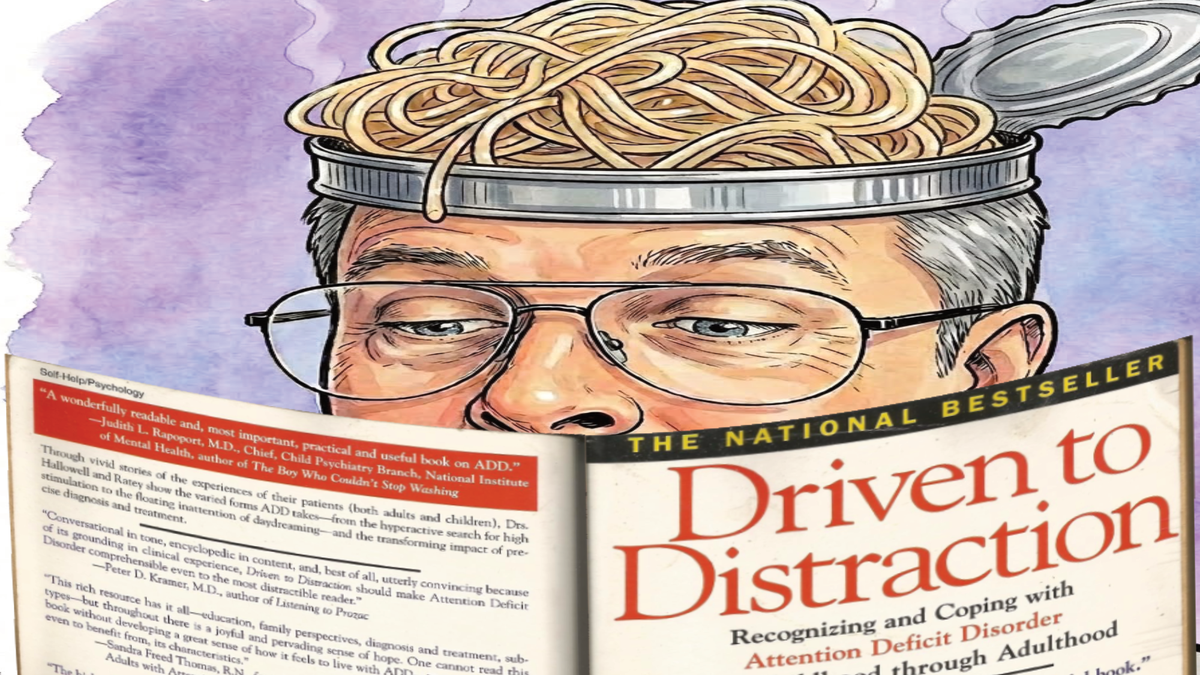
They ran a segment on adult attention deficit disorder featuring Dr. Edward (Ned) Hallowell. He and his colleague, Dr. John Ratey had just published a landmark book, Driven to Distraction.[1]
My kid's mother was there on the couch with me. She was the person who knew me as well as anyone at that point in my life.
The show described the typical ADHD diagnostic profile. Adults and their spouses being interviewed described their experience...
the distraction, the impulsivity, the lack of verbal filters. Hyperfocus states could lock onto something for hours and then suddenly vanish completely. A chronic sense of being just slightly out of sync with how everyone else seemed to operate. Often creative, intuitive, highly intelligent. Intolerance of boredom.[2]
At that moment, my chest contracted like the oxygen left my lungs.
For seven years my kid's mom had been living alongside my particular brand of brain. She wasn't surprised by a single word coming out of that television. What she was watching was clinical language finally arriving and describing what she already knew firsthand.
We looked at each other.
"They're talking about you."
Said together at exactly the same moment. The recognition on both sides was instant, simultaneous, a little bit stunning. The news show wasn't a revelation for her. It was a revelation for me. It was the first time I'd ever heard my own experience described in clinical language by someone with bona fide credentials.
Bona fide. It fit. Right there on that couch. Undeniably, it fit.
Within a week I was asking around for recommendations to a professional who could evaluate me.
Church Connection and The Book
The referral came through a woman at church. Her young son had recently been evaluated and diagnosed with ADHD. The diagnosis was by a well-known Seattle-area psychologist recognized as an authority on both early ADHD diagnosis and the brand-new diagnostic recognition of adult ADHD. Widely published, he was also one of the first clinicians to include adult evaluations in his practice. I was sold and contacted that office.
The Book. After seeing the 20/20 broadcast the week before, I'd purchased Hallowell and Ratey's book, Driven to Distraction.[1:1]
I inhaled the book's contents the way I read things that are trying to tell me something important: compulsively, obsessively, with a highlighter and a growing sense of personal recognition that started at painful and uncomfortable and moved quickly toward uncanny and curious.
Chapter after chapter described thought patterns, behavioral tendencies, and lifelong frustrations. I'd spent a lifetime feeling a sense of personal failing. I'd felt like a stranger to myself, but I hadn't known I was lost.
There's a real distinction in the ADHD experience between suspecting something and knowing it. I could always half-see it, but now it was undeniably clear.
The book described what were new and unsettling parallels to my own life experiences. And I had the sudden, dizzying sensation of seeing myself from an external view for the first time. It was the first time seeing the external me, the one I could recognize while also being introduced to the new me as profiled within the book.
You know what nobody tells you when you suddenly become visible to yourself? Everyone else could already see you. The people at every dinner table, every meeting and conversation, every awkward goodbye in a parking lot. The whole time you were busy being a complete mystery to yourself, people could see you while you could not. That first-time awareness was absolutely terrifying to me.
Hallowell and Ratey didn't treat those things as character flaws. They treated them as a cognitive profile. It was my profile in a documented, researched, clinically recognized book written for me. I devoured their content.
I had always been the kid incessantly feeding his brain: sitting in my information nest of encyclopedias on the hallway floor, editions pulled off the shelves, bookmarked with torn paper scraps, open, and strewn around me. For hours, chasing cross-references and absorbing all the information I could consume.
Driven to Distraction was the new encyclopedia that described me.
I got an appointment with the psychologist.
The Diagnosis
The evaluation was thorough. One component I hadn't anticipated was the collateral interview which is a standard part of a rigorous ADHD evaluation.[3] The clinician didn't just talk to me. He separately interviewed my children's mother. Her observations, her account of living alongside my particular brand of brain for seven-plus years, became part of the clinical record.
That felt clarifying and a bit exposing, but the diagnosis wasn't going to rest solely on my own self-report. Given the ADHD brain's relationship with accurate self-assessment, it's an obvious diagnostic call.[3:1] Someone who had watched me up close, over years, had confirmed the pattern from the outside.
The diagnosis came back: ADHD.
Here's the thing for anyone reading this who might be standing where I was standing back then:
My ADHD diagnosis didn't scare me. It landed as an explanation, not a verdict.
Every frustration, every gap between effort and result, every moment myself, or others had written off as laziness or a character flaw, now had an explanation. I felt solid ground. The general internal sense that I was operating while missing some essential component that everyone else had been issued now had a clinical scaffold. A researched, documented, this is how some brains actually work kind of framework.
The relief of that grounding is difficult for me to overstate.
It was 1995. My life changed.
Twenty Minutes
The psychologist recommended medication. We started with stimulants. Ritalin and its related compounds were available at the time.
Within twenty minutes of my first dose, something major shifted.
It's as though a background noise I had lived with for so long simply ...stopped. The mental static that I had always assumed was just the reality of my brain, what I'd always known thinking just felt like, went quiet. Clarity quiet. Like 5am morning paper-route, serene fresh-snow-quiet before the crunch crunch of boot steps and thoughts mar the etherial setting. Quiet.
Clarity. Like putting on glasses for the first time. Not a transformation. A correction.
It's very common for new patients to experience an instant benefit like that. The stimulants impact on my brain confirmed the ADHD diagnosis more decisively than any test result could have. When a medication produces that exact response within twenty minutes — the static stopping, the clarity arriving — in a brain that has been evaluated and diagnosed, that response tells its own story.[4]
There was just one problem.
My body wouldn't cooperate.
The Einstein Problem
The cognitive clarity on prescription stimulants was real, but my physical body treated every one of them like an invitation to a side-effect uprising.
On stimulants, my brain joined a time-share program with Einstein. Reading became hypersonic-scanning with excellent cognition, absorption, and idea retention. Memory was efficient, organized, and accurate. My smoking synapses were fired-up and humming. Every thought was focused, fast, and connected...
For about forty-five minutes.
Then Einstein went home, took his half of the brain with him, and left me shaking and holding the invoice.
We tried every available stimulant over several weeks. We tried combinations of different stimulants with beta-blockers we hoped would mask the nasty physical side-effects.
My brain loved them all. My body rejected every one.
We eventually settled on Bupropion, a non-stimulant antidepressant with documented efficacy for ADHD symptom management.[5][6]Not the same sharp clarity as stimulants. But functional, sustainable, and something my body would actually accept long-term.
Better than nothing is sometimes exactly enough.
Honestly, that pithy line above is total bullsh¡t. Thirty-one years after, I still think it sucks to know what it feels like having such stunningly vivid cognitive function. To be so close to it and not be able to enjoy it, still makes me wish I had never experienced my brain firing like that to begin with.
The Thing Nobody Was Allowed to Name
Fast-forward two years later to 1997. I'm deep in the PLU MBA program, fighting that same calculus class one final time. The one-class-only strategy I described in the last post. The husband and wife clinical team for IQ assessment, and the second office finalizing my learning disability evaluation.
The husband and wife team were vague. Careful. They suggested I might want to explore additional counseling around cognitive processing and communication. The language was soft enough that I half-registered it and moved on.
The second clinician, the one who administered the learning disability battery after the IQ results came in, was more direct.
She said that I was clearly on the autism spectrum. Directly. Without hedging.
And then she told me she could not put it in writing.
Not because she doubted it, but because the Diagnostic and Statistical Manual of Mental Disorders, Fourth Edition (the DSM-IV) explicitly prohibited a clinician from diagnosing autism spectrum disorder in a patient who already carried an ADHD diagnosis.[7]
My 1995 ADHD diagnosis was already on the record, and her hands were tied by the professional guide governing the entire clinical profession. By formal rule, the two were mutually exclusive. Co-diagnosis was not permitted.[8]
She could see it. She could tell me. She could not diagnose it.
I took that information and put it where I didn't intend to look at again. I walked out of her office and didn't return.
My ADHD and my learning disabilities fit. Academic accommodations overcoming real obstacles to my goals made perfect sense. The thought of my being autistic made me laugh.
That's not me.
The image that word conjured... Autistic...? The kid, not making eye-contact and rocking in the corner with his blanket...getting on the short bus for school. The whole Rain Man character ...who Me?![9]
Autistic was so far outside my realm of self-concept that I didn't look back.
And I didn't open that door again for more than thirty years.
Next in the series: The image in my head that kept me from self acceptance, and what Rain Man actually had to do with it.
Cheers,
— Steve
PS — Please practice grace and kindness ...toward yourself also.
Hallowell, Edward M., M.D. and Ratey, John J., M.D. Driven to Distraction: Recognizing and Coping with Attention Deficit Disorder from Childhood through Adulthood. Pantheon Books, 1994. Dr. Hallowell has been featured on 20/20, 60 Minutes, Oprah, CNN, The Today Show, and many other national media outlets. https://www.penguinrandomhouse.com/books/209384/driven-to-distraction-revised-by-edward-m-hallowell-md-and-john-j-ratey-md/ ↩︎ ↩︎
ADDitude Magazine Editors. "Adult ADHD: A Guide to Symptoms, Signs, and Treatments." ADDitude Magazine. https://www.additudemag.com/adhd-in-adults/ ↩︎
Kooij, Sandra J.J. et al. "The Adult ADHD Assessment Quality Assurance Standard." Frontiers in Psychiatry, July 2024. The gold standard for an adult ADHD diagnostic assessment is a detailed exploration of clinical and behavioral presentation, supported by supplementary and/or collateral information — because ADHD can significantly impair an individual's ability to accurately self-report their own symptom history. https://www.frontiersin.org/journals/psychiatry/articles/10.3389/fpsyt.2024.1380410/full ↩︎ ↩︎
HealthCentral / Ritalin clinical profile. The rapid onset (20-60 minutes for immediate-release methylphenidate) is documented. The subjective clarity, mental static stopping, focus snapping-in, is documented in patient accounts and clinician literature. https://www.healthcentral.com/condition/adhd/ritalin-methylphenidate ↩︎
ADDitude Magazine Editors. "Wellbutrin for ADHD: Effective 'Off-Label' Treatment." ADDitude Magazine. https://www.additudemag.com/wellbutrin-for-adhd/ ↩︎
Cochrane Database of Systematic Reviews. "Bupropion for Attention Deficit Hyperactivity Disorder (ADHD) in Adults." Cochrane, 2017. Bupropion is registered for the treatment of depression and smoking cessation, but is also used off-label to treat ADHD. https://www.cochrane.org/evidence/CD009504_bupropion-attention-deficit-hyperactivity-disorder-adhd-adults ↩︎
Vanderbilt University Frist Center for Autism and Innovation. "AuDHD: The Hidden Dynamics of a Dual Diagnosis." Vanderbilt University, August 2025. "Until the publication of the DSM-5 in 2013, a diagnosis of one of the two conditions precluded a diagnosis of the other." https://www.vanderbilt.edu/autismandinnovation/audhd-the-hidden-dynamics-of-a-dual-diagnosis/ ↩︎
The Transmitter (Spectrum News). "New Rules Allow Joint Diagnosis of Autism, Attention Deficit." The Transmitter, 2013. The DSM-5, published in May 2013, eliminated the prohibition that had prevented clinicians from diagnosing ADHD and autism as co-occurring conditions — a rule that had governed clinical practice since the DSM-IV. https://www.thetransmitter.org/spectrum/new-rules-allow-joint-diagnosis-of-autism-attention-deficit/ ↩︎
My Autism Mind. "How the 1988 Movie Rain Man Changed Autism Perceptions." My Autism Mind, January 2026. Rain Man (dir. Barry Levinson, 1988) significantly shaped public understanding of autism for decades — and significantly narrowed it. The film's portrayal of Raymond Babbitt as a non-verbal savant became the dominant cultural image of autism, contributing to widespread misunderstanding of the spectrum's actual diversity. https://myautismmind.com/rain-man/ ↩︎