Masking & 30 Years of Performing Neurotypical
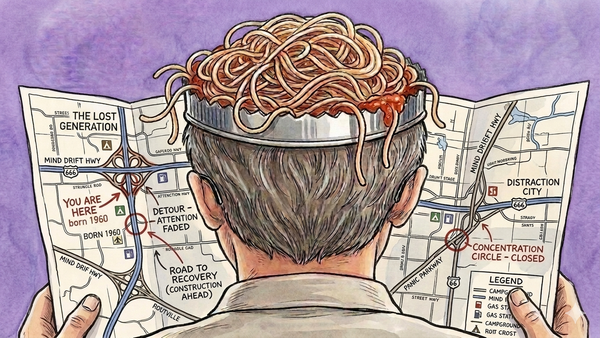
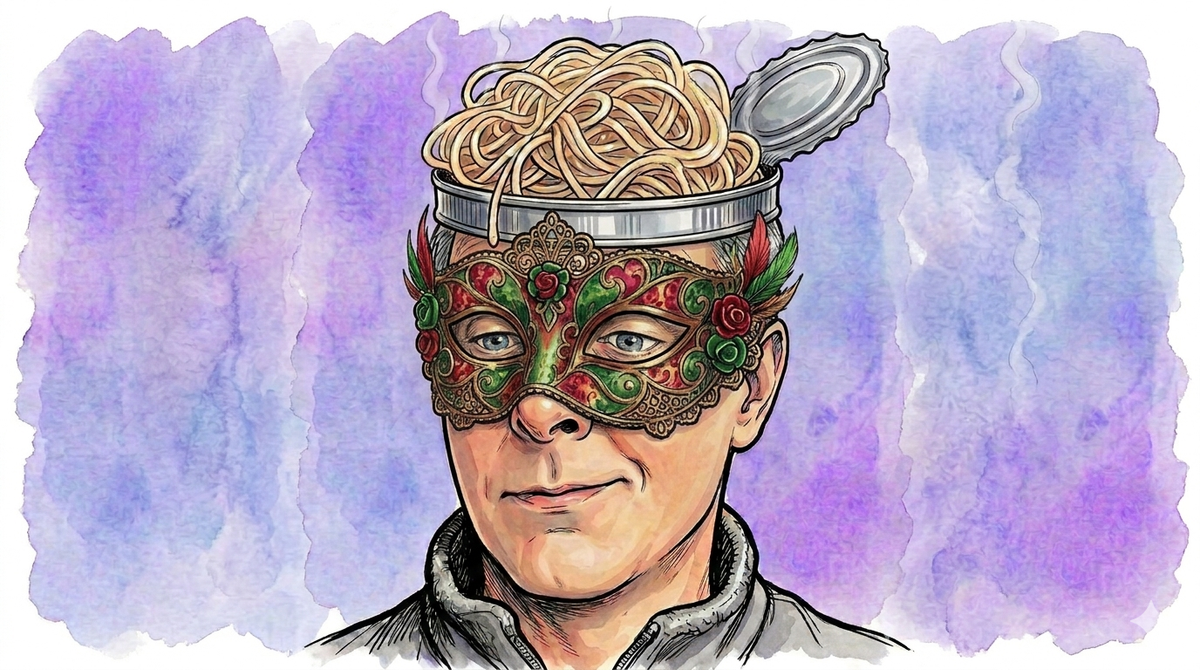
Dual human Operating Systems: normal is running on the surface while masking is draining system energy too
This is the sixth installment of an eight-part Intro Series. If you just finished The Stereotype Prison, Rain Man and the Short Bus for 30-Years, you remember where it left off. Rain Man evicted from my brain. Alarm Guy back in his chair. Manager Guy back to his donut. Sixty-five-year-old me, sitting up in a Hawaiian hotel bed, ready to "get to work." This post is about the thirty years in between. Not what I believed about autism, but what I was doing about it, every single day, without ever knowing I was doing anything at all.
Masking, the Setting Nobody Sees
Here's a one-word answer I said a million times for thirty years with no idea the word had a clinical definition: ”Fine.”
How are you? Fine. How was the meeting? Fine. How was your week? Fine, fine, fine…
There's a name now for what was actually running underneath that word: camouflaging, or masking, depending which corner of the research you're standing in. I named it for the first time two posts back, watching Young-Steve hopelessly try to camouflage himself so he'd fit in.
Naming a thing once isn't the same as understanding what it costs to run it for thirty years straight.
The clinical literature draws a finer line than I did: Camouflaging is the umbrella term, all the strategies autistic people use to get by in a non-autistic world.
Camouflaging is like three different muscles, all flexed at once, all invisible from the outside:
-
Masking sits underneath it. Masking is suppressing or hiding the visibly autistic stuff while projecting a different persona.
-
Compensation is the active version: scripting conversation topics ahead of time, studying facial expressions, memorizing the rules of eye contact well enough to fake having absorbed them naturally.
-
Assimilation is just trying to blend, mirroring whoever's in the room, swallowing whatever discomfort shows.[1]
Masking isn't lying. Nobody sat me down and told me to pretend to be someone else. It's closer to a setting, or a background process. It’s the brain-spaghetti version of an app you forgot was even open, quietly draining the battery the whole time.
While a normal conversation is happening on the surface, the masking process is running underneath it too:
Is this the right amount of eye contact? Is my voice too flat, too loud? Did that joke land? Should I have said something back there? Wait, what did they just say, I missed it because I was too busy monitoring my own face.
All of that, at the same time as actually trying to participate. Einstein doesn't even clock in for this shift. This was just regular old me, running two operating systems at once, all day, every day, for thirty years.
Every day. All day. Exhausting.
Motivation. Performance. Bill.
The foundational study on camouflaging, out of University College London and Cambridge, interviewed 92 autistic adults and found the same three-stage pattern showing up again and again.[1:1]
- Stage one is motivation: fitting in, building relationships, avoiding stigma, staying safe. Ordinary human wants. The difference is the amount of continuous effort it takes to chase them while autistic.
- Stage two is the performance itself: forcing eye contact, scripting conversations, mimicking the people nearby, suppressing whatever your body actually wants to do, all in service of looking unremarkable.
- Stage three is the energy bill: short-term exhaustion and relief at having passed, long-term erosion of self-perception and what the researchers call "challenges to one's sense of authentic self."
Two years later, the same research team built a way to measure it. The Camouflaging Autistic Traits Questionnaire, the CAT-Q, gave camouflaging a number for the first time, broken into compensation, masking, and assimilation subscales.[2]
What the measurement scale confirmed:
Autistic adults score significantly higher than non-autistic adults on every subscale, and the scores climb with age.
The behavior compounds. It doesn't fade. Translation:
“The longer you camouflage without knowing why you're doing it, the deeper it gets embedded into every interaction, every job, every relationship you have.”
The masking didn't switch on within some random time or place in my thirties. It switched on a long time before that, back when I was a kid, in places that had nothing to do with careers or diagnoses. A Little League baseball dugout. A public community concert.
Masking began where the rules of "fitting in" and the consequences of “Miswired Me” were already being learned the hard way. It was long before I had any language for what I was doing or why.
Thirty Years, Three Careers
Whatever that early version of the mask looked like, by adulthood it had a job. I first built a corporate sales career on top of it. Built a marriage on top of it. Raised two kids on top of it. Earned an Economics degree and an MBA on top of it, one class at a time, with the Calculus Minions firing at me from the tree line the whole way through.
Sales, if you've never done it, runs on almost exactly the muscles that masking already exhausts. Reading a room. Performing enthusiasm whether or not you feel it that day. Small talk before the real talk. Gathering data. Knowing who in the room actually make the decisions, monitoring and adjusting your whole performance around them. For most people that's a skill.
For me it was the skill, deployed at full volume eight or nine hours a day, stacked on top of the masking I was already doing trying to function as a “normal person” in a room.
And here's the part that took thirty years and a Hawaiian hotel room to see clearly. I always knew the job didn't fit. I just had the wrong reason why.
From my own notes, written years before any of this had a name:
"My MBA is also my escape route…a way to get out of a career, a corporate sales career, where I didn't fit. I figured I'd leverage the degree to get into a different industry, a different sales job, a different company. That's always been the way that's worked best for me in the past."
Read that again. A different sales job. A different company. Not a different kind of work. I wasn't trying to escape sales. I was trying to escape this sales job, in this company, with these people, because surely the problem was the specifics. Surely a different conference room would feel different.
It never did. The conference room was never the problem. The setting running underneath me was the problem, and I was about to carry it, fully installed, into every new career I ever walked into, including a successful real estate appraisal practice, and a third company as a general contractor.
What the Research Calls It Now
Turns out fine, running as a permanent background process, has a name in the research too, and lately some studies have started looking specifically at people who sound a lot like me.
A 2023 study out of University College London looked at masking in the workplace, comparing autistic adults, other neurodivergent adults, and neurotypical adults. All three groups masked at work, for all kinds of reasons.
But the autistic and neurodivergent participants described something the neurotypical group mostly didn't: masking wasn't just useful, it felt necessary, because most workplaces still don't understand neurodivergence well enough to make masking optional.[3]
Translation: the scene itself was set before I ever walked into it. I wasn't bad at my job. I was good enough at a second, invisible job that nobody else knew I was also doing.
Running that second job for thirty years has a name too:
Autistic burnout, defined in the research as chronic exhaustion, loss of previously held skills, and reduced tolerance for everyday sensory and social demands, building up over months or years from a mismatch between what life keeps demanding and the support actually available to meet it.[4]
Masking is also one of the main reasons autism gets missed or caught late.[5] When someone shows up in a clinic or a classroom looking, sounding, and behaving like everyone else, nobody goes looking for the autism that's actually driving the need for masking in the first place. The masking delays the diagnosis. The undiagnosed keep masking. Round and round.
The two feed each other for decades.[6] Autism researcher Leonie Mercedes put it plainly, writing about the moment of late diagnosis:
People who get diagnosed as adults have usually been masking for most of their lives, hiding parts of themselves to fit a neurotypical majority, performing another identity both on purpose and without realizing it.[7]
And a 2026 study comparing autistic adults diagnosed earlier in life to those diagnosed later, like me, found one thread showing up again and again in the later-diagnosed group: not knowing why any of this was happening, and quietly blaming yourself for it the whole time.[8] That's thirty years, named in one sentence.
The mental health cost of all that running shows up in the numbers too. A 2024 study of 342 autistic adults found high masking strongly associated with depression, anxiety, interpersonal trauma, reduced authenticity, and lower self-esteem.[9] The mechanism is straightforward enough to state plainly: sustained suppression of who you actually are, across a lifetime, produces a measurable cost. It doesn't show up as one bad day. It shows up everywhere, eventually.
When the Mask Fuses with the Face
Researchers Pearson and Rose call masking less a deliberate choice than an understandable response to a culture that has pathologized autism for decades.[10] Their argument is that masking gets woven into identity itself rather than layered on top of one.
For someone who started masking in early childhood, the way I did, there often isn't a clean line left between the performance and the person.
By the time you reach your sixties, you're not removing a costume. You're trying to find the seam.
The National Autistic Society describes where that road ends, plainly:
"This can lead to an identity crisis and loss of a sense of self."[11]
A 2021 qualitative study of autistic adults' camouflaging experiences put that same finding in participants' own words. People described being told they, "seemed more autistic" since their diagnosis, and pushing back on it, insisting they'd actually always been exactly this way.[12]
The mask was never a disguise worn over a fully formed self underneath. For a lot of us, it was installed before that self ever got the chance to finish forming.
Two Operating Systems, One Mask
For someone carrying both an autism and an ADHD diagnosis, the masking picture gets more complicated. A 2024 study comparing camouflaging across autistic adults, ADHD-only adults, and a non-autistic group found that both autistic and ADHD adults camouflage significantly more than neurotypical adults, with autistic adults camouflaging the most.[13]
And within the specific behavior of blending in, autistic traits turned out to be the stronger predictor, even for people whose presentation leaned mostly ADHD. Translation, for me: the autism engine was doing more of the driving the whole time, even back when ADHD was the only diagnosis on the table.
That's not a small detail. The DSM-IV banned clinicians from diagnosing autism in anyone who already carried an ADHD diagnosis, from 1994 to 2013. Mine landed in the middle of that time period.
Which means the one clinical question that might have caught the autism, could this also be autism, was never legally allowed to be asked. Not missed. Not overlooked. Off the table by policy, for the entire stretch I needed it most.
Two engines, each trained independently, each demanding its own performance: attention and impulse control on one side, social communication and sensory load on the other. Running both, at once, for thirty years, without anyone, including me, ever being allowed to ask whether they were connected.
The Fortunate Pairing
Here's the part of my notes from that first night in Hawaii I keep coming back to:
”What has sustained me, and what I'm thankful for, is being paired up with what we used to call a gifted IQ, alongside processing and learning disabilities. It's a very fortunate pairing, because it's allowed me to survive, and to make it to the age of 65, where I can finally embrace this stuff and truly start to understand it."
I think that's the honest center of this whole post. The same brain that could hyperfocus its way through an encyclopedia set, or stubborn its way through a calculus class that should have ended me multiple times, is the same brain that built a thirty-year mask convincing enough to run a sales career, a marriage, and two kids underneath it.
My gifted-IQ side didn't sit there uselessly while the rest of me struggled. It was in on it. It built the masking survival costume.
And that's exactly why the bill went unnoticed for so long. The better the performance, the less anyone, including me, had any reason to ask what it was costing backstage.
"It's been quite dumb," my own notes say, about thirty years of this. "It's been kind of cool now" too, looking back at it from here. Both of those are true, and I'm done pretending they cancel each other out.
The bill has a name now. Camouflage. Masking. Burnout. Thirty years of a fortunate pairing, Autism/ADHD and Gifted-IQ, working together and quietly covering for themselves.
Not Just Me
Now that I have a name for it and understand masking, what I keep thinking about isn't really about me anymore. It's about how many other people my age are still unknowingly masking, running this exact background process today right now, with no idea it exists and has a name too.
That fact grabs me. A 2025 review out of King's College London, the largest of its kind, found that:
97 percent of autistic adults over 60 in the UK have never been diagnosed.[14] Ninety-seven percent.
Nobody's even run that number for the US yet, but there's no good reason to think the curve looks different on this side of the ocean. That's not a handful of people quietly running the same background process I ran for thirty years. That's most of an entire generation.
I need to do something about that stat and information. Hopefully I can become a change agent. A voice to share information and hope. I'm not sure what makes one an advocate, but I understand encouragement. As I'm learning, maybe Miswired.me will become both.
Researching and writing this post has unlocked quite a bit of self-understanding since embracing my own autism diagnosis earlier this year. As a result, there's definitely a new post and/or a new post series brewing now...
More on that soon.
Until next time.
Cheers,
— Steve
PS — If the mask slips for five minutes today, on purpose or by accident, let it. Five minutes counts.
Endnotes
Hull, L., Petrides, K.V., Allison, C., Smith, P., Baron-Cohen, S., Lai, M-C., and Mandy, W. "Putting on My Best Normal: Social Camouflaging in Adults with Autism Spectrum Conditions." Journal of Autism and Developmental Disorders, 2017. https://pmc.ncbi.nlm.nih.gov/articles/PMC5509825/ ↩︎ ↩︎
Hull, L., Mandy, W., Lai, M.-C., Baron-Cohen, S., Allison, C., Smith, P., and Petrides, K.V. "Development and Validation of the Camouflaging Autistic Traits Questionnaire (CAT-Q)." Journal of Autism and Developmental Disorders, 2019. https://pmc.ncbi.nlm.nih.gov/articles/PMC6394586/ ↩︎
Pryke-Hobbes, Amber, et al. "The Workplace Masking Experiences of Autistic, Non-Autistic Neurodivergent and Neurotypical Adults in the UK." PLOS ONE, Vol. 18, No. 9, 2023. https://journals.plos.org/plosone/article?id=10.1371/journal.pone.0290001 ↩︎
Raymaker, Dora M., et al. "'Having All of Your Internal Resources Exhausted Beyond Measure and Being Left with No Clean-Up Crew': Defining Autistic Burnout." Autism in Adulthood, Vol. 2, No. 2, 2020. https://doi.org/10.1089/aut.2019.0079 ↩︎
Cook, J., Hull, L., Crane, L., and Mandy, W. "Camouflaging in Autism: A Systematic Review." Clinical Psychology Review, 2021. https://pubmed.ncbi.nlm.nih.gov/34563942/ ↩︎
Klein, J., Krahn, R., Howe, S., Lewis, J., McMorris, C., and Macoun, S. "A Systematic Review of Social Camouflaging in Autistic Adults and Youth: Implications and Theory." Development and Psychopathology, 2025. https://pubmed.ncbi.nlm.nih.gov/39370528/ ↩︎
Mercedes, L. "Late Autism Diagnosis: It's a Relief, but Who's Behind the Mask?" Psyche, 2024. https://psyche.co/ideas/late-autism-diagnosis-its-a-relief-but-whos-behind-the-mask ↩︎
Ali, Dorota, Will Mandy, and Francesca Happé. "How Does 'Autistic Burnout' Feel? A Qualitative Study Exploring Experiences of Earlier- and Later-Diagnosed Autistic Adults." Autism, 2026. https://pmc.ncbi.nlm.nih.gov/articles/PMC13005893/ ↩︎
Evans, J.A., Krumrei-Mancuso, E.J., and Rouse, S.V. "What You Are Hiding Could Be Hurting You: Autistic Masking in Relation to Mental Health, Interpersonal Trauma, Authenticity, and Self-Esteem." Autism in Adulthood, 2024. https://pubmed.ncbi.nlm.nih.gov/39139513/ ↩︎
Pearson, A. and Rose, K. "A Conceptual Analysis of Autistic Masking: Understanding the Narrative of Stigma and the Illusion of Choice." Autism in Adulthood, 2021. https://sure.sunderland.ac.uk/id/eprint/13122/1/13122.pdf ↩︎
National Autistic Society. "Masking." National Autistic Society, 2024. https://www.autism.org.uk/advice-and-guidance/behaviour/masking ↩︎
Bradley, L., Shaw, R., Baron-Cohen, S., and Cassidy, S. "Autistic Adults' Experiences of Camouflaging and Its Perceived Impact on Mental Health." Autism in Adulthood, 2021. https://pmc.ncbi.nlm.nih.gov/articles/PMC8992917/ ↩︎
van der Putten, W.J., Mol, A.J.J., Groenman, A.P., Radhoe, T.A., Torenvliet, C., van Rentergem, J.A.A., and Geurts, H.M. "Is Camouflaging Unique for Autism? A Comparison of Camouflaging Between Adults with Autism and ADHD." Autism Research, Vol. 17, No. 4, 2024. https://doi.org/10.1002/aur.3099 ↩︎
Stewart, G.R. and Happé, F. "Aging Across the Autism Spectrum." Annual Review of Developmental Psychology, Vol. 7, 2025. https://doi.org/10.1146/annurev-devpsych-111323-090813 ↩︎