The Lost Generation: Millions of Missed Adult Autism Diagnoses
Late Autism Diagnosis of Adult Autism: Two locked doors, thirty years, and an entire generation left uncounted
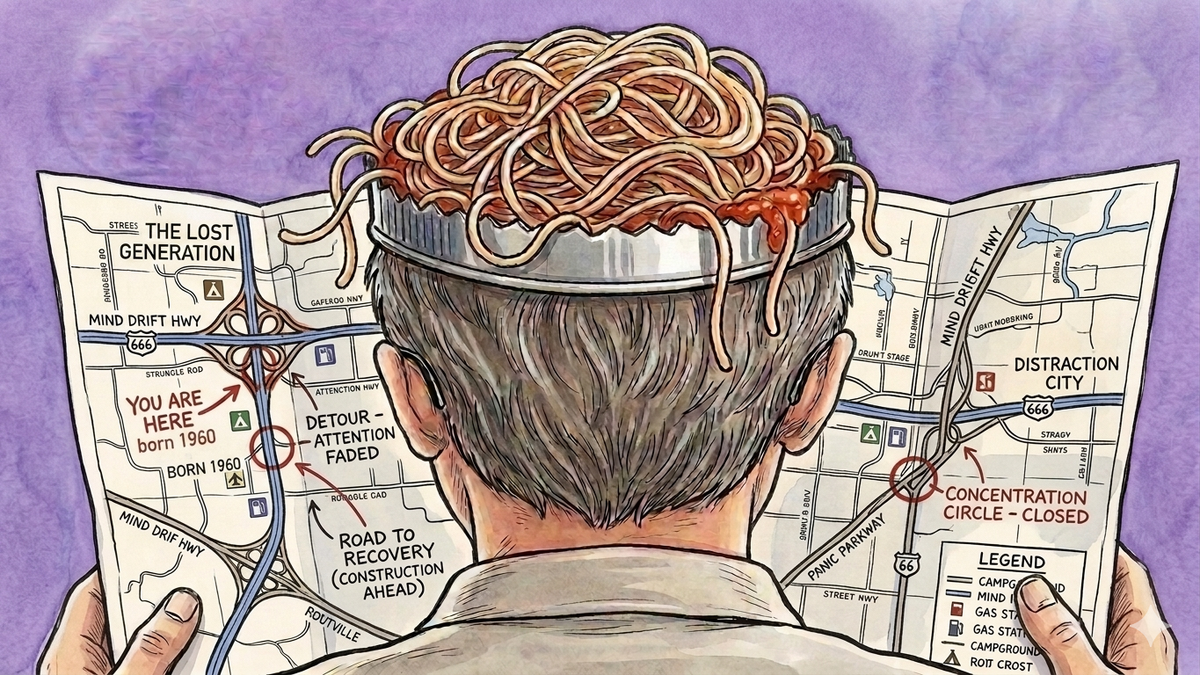
This is the seventh installment of an eight-part Intro Series. During these posts, I've told you about my autism diagnosis that I refused, a movie poster that explained why I pushed that original diagnosis away, and the thirty-some years of masking that kept me hidden, including from myself. This is the post I've been building toward. It's the part of my story that turns out to be the same story of millions (yes, millions) of others as well.
The Thought That Came After the Aha
You already know about the Hawaii night. Sally asleep beside me, the little spinning AI icon turning on my iPad, thirty years of autism denial finally cracking open at age sixty-five. That was the aha... the part about me.
This post is about the thought that arrived a few minutes later.
Once the wall came down, my curiosity did the only thing it knows how to do. My curiosity started feeding.
More input.
I read everything I could find about late-diagnosed autism and autism in general. I fed my brain the same way I once read a hallway floor's worth of encyclopedias. Somewhere in that learning frenzy I hit a phrase that grabbed me.
The lost generation.
Not my phrase. The researchers'. And the instant I read it, I understood something I hadn't yet considered.
It wasn't JUST me.
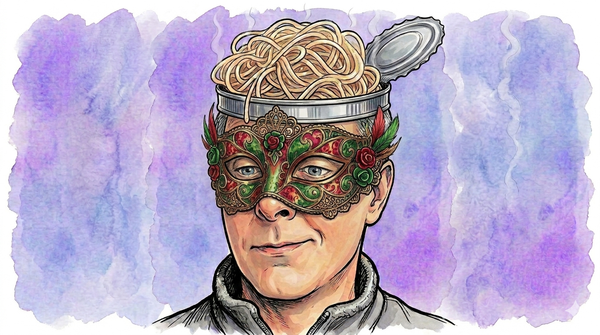
There are tons of people my age who are also miswired exactly like me who went through their lifetime without the word autism. People in their fifties, sixties, seventies, walking around right now missing the same memory index file, in their brains, living with the same brain spaghetti, experiencing the same lifelong sense of being a step behind and out-of-step with life. They feel like I've felt my whole life, and they have no idea there's a name for all of it.
And the very first thing my stubborn, written-expression-disordered, idea-flooded brain wanted to do with that realization was the thing it always wants to do:
Tell somebody...and write about it.
A Name for the Missing
Turns out the lost generation isn't just a phrase. It actually appears in the clinical psychology literature.
In 2015, two autism researchers, Meng-Chuan Lai and Simon Baron-Cohen, used "the lost generation" to describe adults who were either previously excluded from a diagnosis of classic autism, or if they were recognized at all, it was much later in life.[1]
These are the people the former diagnostic protocols left out. Not the kids who fit the Rain Man stereotype, but the rest of us. The ones without an obvious developmental delay. The people who learned to camouflage and were good at masking. The ones whose autism was overshadowed by something else.[1:1]
Later, researchers expanded the list of people who were missed by the old (or lack of) diagnostic protocols. The people most likely to be missed were women, people with higher measured intelligence, and older adults who came of age before the diagnostic criteria included them.[2] Gifted IQ, late birth year, good at masking. Check, check, check.
That's The Lost Generation. I'm a member. I dropped this phrase a couple of posts back almost in passing, and as I researched this post, I found myself curious:
How does an entire generation go missing in plain sight?
Because it wasn't an accident. And it definitely wasn't some shared character flaw. How do a few million people, born from the late-1940s to 1976, all coincidentally fail to notice themselves?
Millions?! That just seems insane.
What caused it was the three-piece architecture of psychology at the time.
How Do You Lose a Generation?
One: the word kept changing shape. When I was a kid, autism as we use it now barely existed as an adult category. It didn't get its own line in the psychiatric manual until 1980, when I turned twenty. Autism didn't become a spectrum until 1994 (when I turned thirty-four), and didn't get pulled into one unified diagnosis until 2013, when I reached age fifty-three. The target moved my whole life. For most of my life, the word autism simply didn't fit a guy like me.
Two: we got good at hiding. I wrote an entire post on masking, so I'll keep it short here:
the better you mask, the more invisible you become to the very system that might have caught you.
A lifetime of performing fine is a lifetime of evidence that nothing's wrong. Masking doesn't just exhaust you. It erases you from the record.
Three: the psychology rulebook forbade it. When I look back, this is the part of the psychology architecture of the time which frustrates me the most. It happened to me directly, and I didn't grasp what was right in front of me.
In 1997, a psychiatrist told me, out loud and without hedging, that I was on the autism spectrum. And then she told me she couldn't formalize it as a written diagnosis. Not because she doubted it, but because the rulebook, the Diagnostic and Statistical Manual of Mental Disorders, or DSM, Fourth Edition, flatly prohibited diagnosing autism in anyone who was already diagnosed with ADHD.[3] Two years before, in 1995, I'd been diagnosed with ADHD. Per the 1994 DSM-IV, the two could not coexist inside the same person. Dual-diagnosis was forbidden.
It wasn't just my bad luck. The rule was printed in every psychology clinician's manual in the country. That bizarre and unsupported rule governed the entire psychology profession for 19 years until the DSM-5 finally struck it down in 2013.[4]
Millions of People and Me
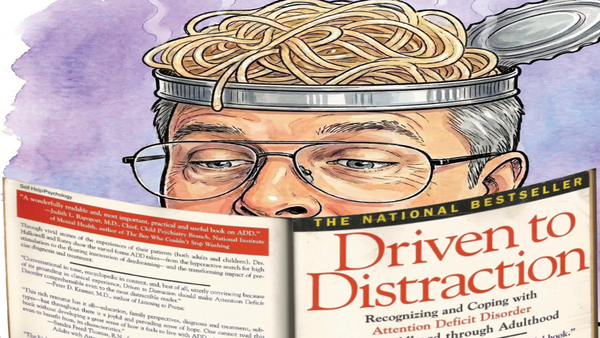
People my age, and roughly a range of people born ten years before and ten years after me, got handed the ADHD label first. Which makes sense, given that the book Driven to Distraction put adult ADHD on TV.
Millions of us ended up in the same vacuum, with the same medical contradiction. The psychiatrist could see my autism plain as day. She wasn't allowed to write my diagnosis.
Me. One person. One afternoon. One door locked. Now do that over and over, for thirty years, in every psychology office in the world. The result is "Me" multiplied by millions.
A lost generation.
In that thirty-years-of-hindsight kind of way, it's funny. My own brain's Alarm Guy reacts defensively and slams the door on any threatening idea before his coworker, Manager Guy, looks up from his donut. It turns out the whole clinical psychology system had an Alarm Guy too, but with a different name.
Alarm Guy in the DSM-IV was named Exclusion E (roughly pages 83-85, depending on the edition).
A single rule in a single book, slamming the door shut on an autism diagnosis for an entire generation.
The Medical Bill in Stealth Mode
There was a second lock on that door, and it was money.
When I was getting evaluated in the mid-1990s, mental-health care was not covered the way physical medical care was covered. When mental-health care was covered at all, there were different limits, different caps, and different rules. I paid for those mental-health evaluations on credit cards, because insurance back then simply did not treat a brain the way it treated a knee.
Federal parity started under a 2008 law, but it was the Affordable Care Act, in 2010, that made mental-health and substance-use services one of ten essential health benefits and extended those protections to the kinds of plans that had never bothered to offer them.[5]
Here's the point. Even the people of my generation who suspected something often couldn't afford to pursue a diagnosis. Diagnostic gatekeeping on one side, a credit-card-only entry fee on the other. Two locks, one door, a whole generation locked out from an autism diagnosis.
Why It Matters That We Were Missed
There's a cost to being missed. Going undiagnosed for decades is not some harmless clerical oversight. Autistic adults have higher rates of anxiety and depression than the general population, and going year after year undiagnosed as autistic perpetuates real damage.
In 2022, researchers at Cambridge went through the records of people in England who had died by suicide and found that a lot of them were likely autistic and never diagnosed. What they called for was earlier diagnosis and actual support afterward.[6]
That research alone shows what a late diagnosis actually is. It isn't a trophy you pick up at sixty-five. For a lot of people my age, it's the first time anybody handed them an accurate picture of who they are.
That's huge, and it's invaluable even when it shows up forty years late.
The Part Where It Gets Better
The good news, which I've experienced since January 2026, and what I hope the rest of the lost generation gets to hear: late autism diagnosis still helps.
The first thing I felt during that January week in Hawaii was plain relief. Not like the "plop-plop, fizz-fizz relief" of that old TV commercial, but a deeply freeing, grounded sense, a lifetime of relief.
Like myself, most people report this sense of late autism diagnosis relief. One study of men diagnosed as adults found the diagnosis finally gave them an explanation for a lifetime of trouble and many felt the first self-acceptance they'd ever had.[7]
When researchers asked late-diagnosed adults how it felt, the answers came back mostly positive: relief, a clearer picture of themselves, a way to get support, and pride in who they are.[8]
It also gets easier with time. The people who get all the way to being proud of being autistic tend to have higher self-esteem than the ones still fighting it.[9] So a sense of fighting it looks like a phase you'll eventually come out the other side of after initial diagnosis.
But keep fighting! Learn everything you can about your autism and apply it to your self-introspection and the perspective you can apply to yourself as a new filter for reviewing your memories. Research grounded information applied to our headspace gives a whole new dimension to our self-understanding.
The Numbers
A lot more of us, late-diagnosed adults, are turning up in the numbers now. A 2024 study of more than twelve million people found autism diagnoses going up across every group, with the biggest jump, 450 percent...whoa!...among adults in their late twenties to mid-thirties.[10] About 2 percent of adults are now thought to be autistic.[11]
The researchers were careful to say even those numbers probably miss a lot of older people, older women most of all, who were never spotted as kids and haven't been spotted since.
Back in the masking post, I told you I couldn't let one stat go, and that there was more coming. Here it is. A 2025 review out of King's College London found that 97 percent of autistic adults over 60 in the UK have never been diagnosed.[12] Ninety-seven percent.
Put that next to the numbers above and it's the same story from a different angle. Diagnoses are climbing fast in one direction, adults in their late twenties to mid-thirties, and staying almost invisible in the other, adults over 60. Same condition. Same brains. Just a difference in who anybody thought to look for.
Autistic kids were always there. What changed is that people finally started looking for the grown-up version, with a word that fit us.
We were never gone. We just never got counted.
You're Still Here. So Am I.
If you've read this far and something keeps nagging at you, some old suspicion that the standard wiring never quite matched yours, this part is for you.
You are not broken, you are not alone, and it is not too late.
Get curious and feed your brain. More input, like Johnny 5, the robot from the movie Short Circuit, dragging encyclopedias down the alley. Read the autistic writers. Take the online screenings. If you want a real assessment, go find someone who understands what this looks like in an adult who has masked for a lifetime. And if you don't want a formal label (or, you don't have the resources to spend on formal diagnosis) that's fine too. Recognizing yourself counts, and the research treats self-identified autistic adults as part of this same lost generation.
Find your people. The folks who study autistic community say that finding your people gives you three things: belonging, real friendship, and what they call political connectedness, which is just a roundabout way of saying advocacy. Advocacy is caring about the others still stuck behind the locked door. That kind of connection is tied to better self-esteem, a sense of direction, and steadier mental health.[13]
Advocacy. I told you my first instinct was to tell somebody the second I understood the lost generation was real. That's really what advocacy is all about. I want to speak up for people, and I want to encourage people the way I've been encouraged. I don't have a stage or any credentials, but I have a story, and I have a stubborn energy.
Tell your story to one person. You've got that much too. That's where it starts.
We're not invisible anymore.
They called us the lost generation. Past tense. I like the past tense of called, because it means somebody is finally counting.
We were here the whole time, building our encyclopedia nests, beating the calculus minions at midnight, masking through careers and marriages for decades...lost and invisible.
We're visible now. I see me. I see you.
We're still here too.
Time to get to work.
Until next time.
Cheers,
— Steve
PS — Please practice grace and kindness ...to yourself...and toward everyone still finding out exactly who they are and who they've always been.
Endnotes
Lai, Meng-Chuan and Baron-Cohen, Simon. "Identifying the Lost Generation of Adults with Autism Spectrum Conditions." The Lancet Psychiatry, Vol. 2, No. 11, 2015. https://pubmed.ncbi.nlm.nih.gov/26544750/ ↩︎ ↩︎
McDonald, Tammy A.M. "Autism Identity and the 'Lost Generation': Structural Validation of the Autism Spectrum Identity Scale and Comparison of Diagnosed and Self-Diagnosed Adults on the Autism Spectrum." Autism in Adulthood, Vol. 2, No. 1, 2020. https://pmc.ncbi.nlm.nih.gov/articles/PMC8415774/ ↩︎
Vanderbilt University Frist Center for Autism and Innovation. "AuDHD: The Hidden Dynamics of a Dual Diagnosis." Vanderbilt University, August 2025. https://www.vanderbilt.edu/autismandinnovation/audhd-the-hidden-dynamics-of-a-dual-diagnosis/ ↩︎
The Transmitter (Spectrum News). "New Rules Allow Joint Diagnosis of Autism, Attention Deficit." The Transmitter, 2013. https://www.thetransmitter.org/spectrum/new-rules-allow-joint-diagnosis-of-autism-attention-deficit/ ↩︎
Centers for Medicare & Medicaid Services. "The Mental Health Parity and Addiction Equity Act (MHPAEA)." CMS.gov. https://www.cms.gov/marketplace/private-health-insurance/mental-health-parity-addiction-equity ↩︎
University of Cambridge. "Study Reveals High Rate of Possible Undiagnosed Autism in People Who Died by Suicide." University of Cambridge, February 2022. https://www.cam.ac.uk/research/news/study-reveals-high-rate-of-possible-undiagnosed-autism-in-people-who-died-by-suicide ↩︎
Lupindo, Bomikazi M., Maw, Anastasia and Shabalala, Nokuthula. "Late Diagnosis of Autism: Exploring Experiences of Males Diagnosed with Autism in Adulthood." Current Psychology, 2022. https://pmc.ncbi.nlm.nih.gov/articles/PMC9361958/ ↩︎
Atherton, Gray. "How Age and Age of Diagnosis Affect Quality of Life." Autism Research Institute, January 2025. https://autism.org/age-and-diagnosis/ ↩︎
Corden, Kirsten, Brewer, Rebecca and Cage, Eilidh. "Personal Identity After an Autism Diagnosis: Relationships With Self-Esteem, Mental Wellbeing, and Diagnostic Timing." Frontiers in Psychology, Vol. 12, 2021. https://pmc.ncbi.nlm.nih.gov/articles/PMC8360844/ ↩︎
Grosvenor, Luke P. et al. "Autism Diagnosis Among US Children and Adults, 2011-2022." JAMA Network Open, Vol. 7, No. 10, 2024. https://pmc.ncbi.nlm.nih.gov/articles/PMC11525601/ ↩︎
Collier, Stephanie (reviewer). "Autism: The Challenges and Opportunities of an Adult Diagnosis." Harvard Health Publishing, 2024. https://www.health.harvard.edu/mind-and-mood/autism-the-challenges-and-opportunities-of-an-adult-diagnosis ↩︎
Stewart, Gavin R. and Happé, Francesca. "Aging Across the Autism Spectrum." Annual Review of Developmental Psychology, Vol. 7, 2025. https://doi.org/10.1146/annurev-devpsych-111323-090813 ↩︎
Botha, Monique, Dibb, Bridget and Frost, David M. "'It's Being a Part of a Grand Tradition, a Grand Counter-Culture Which Involves Communities': A Qualitative Investigation of Autistic Community Connectedness." Autism, Vol. 26, No. 8, 2022. https://pmc.ncbi.nlm.nih.gov/articles/PMC9597163/ ↩︎