Stereotype Prison: 30 years, Rain Man, the Short Bus
The movie. The short bus. The image I mistook for the whole truth about autism …for thirty years.
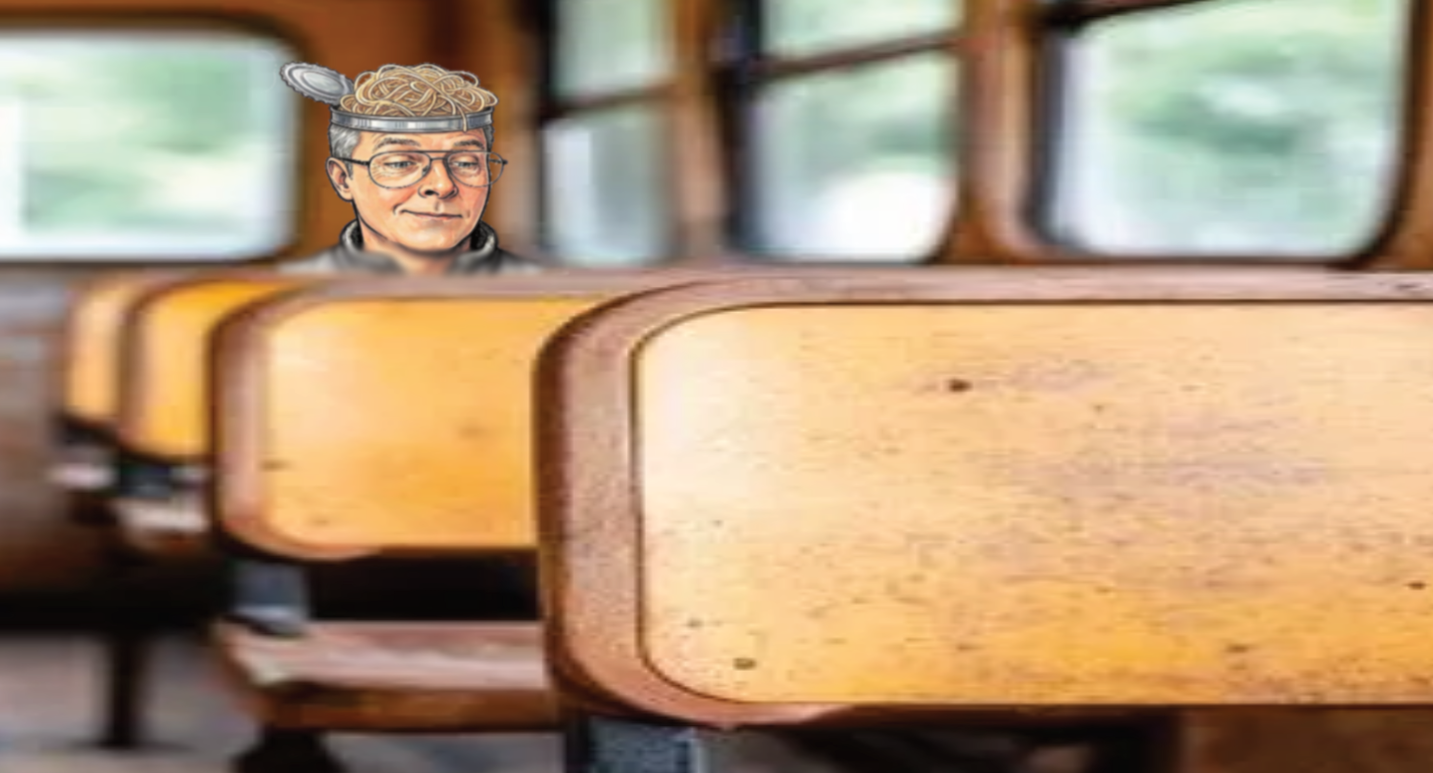
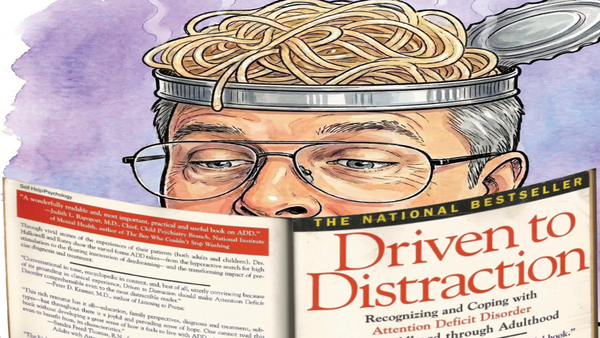
This is the fifth installment of an eight-part Intro Series. If you just finished Driven to Distraction, My ADHD Diagnosis, you’ll remember how it ended. A psychiatrist told me I was on the autism spectrum. I flat out rejected that. I walked out of her office, closed the door, and ignored that diagnosis for over thirty years. This post is about why the idea bounced off me the instant she said it. What does an autistic and ADHD brain do with an idea it completely dismisses?
“That’s Not Me.”
My response was three words, inside my head, the instant a credentialed professional told me that I was autistic:
That’s not me.
Firm. Immediate. The End. Not an instinctive thought so much as a reflex…the mental equivalent of yanking your hand off a hot stove. You may already know the culprit. That was my Alarm Guy. The trigger-happy Amygdala Dude, in my brain slamming every red button on the alarm console before his co-worker, Manager Guy, could so much as look up from his donut.
The word autistic came through the door. Alarm Guy decided it was a threat. He slammed shut the control room door on that idea and locked it out.
But what exactly set off Alarm Guy wasn’t the word. It was the mental image the word autistic dragged in with it.
When I heard “autistic,” I didn’t see myself. I saw a mental image of some other kid. A very specific other kid, not me. The kid I saw was not making eye contact as he’s walking from the back of the bus. He’s fourteen years old or so, climbing down the steps of the short bus, and heading into his elementary school classroom ...at the age of fourteen.
And in my head, right behind him in the cafeteria ...is Rain Man, squatting on the floor, counting toothpicks, mumbling something about Qantas, and reciting detailed baseball player statistics.
Those two look just like autism (or do they?) Them ...not Me.
Obviously not ME.
I had an MBA in progress, two young children, and a thriving corporate sales career. My brain, when I was fourteen, could sit on the upstairs hallway floor, hyper-focused and chasing cross-references through a bookcase of encyclopedias for nine hours straight. The word and the image did not fit the Me I knew.
So I did what all of us do with something that doesn’t fit:
After my brain’s instant verdict, that’s not me. I brushed it off.
Done. Dismissed. Forgotten.
But I was wrong about one thing. That referenced image of Rain Man, Dustin Hoffman, in my head? It wasn’t an accurate representation of autism.
It was a picture of one movie.
Where the Image Came From
To be fair to 1997-Me. I didn’t conjure that mental image from nothing. The same reference was pushed into millions of people’s brains during the 1990s, and it persists within some heads to this day. We were all handed that stereotypical image representing “autism.”
The movie Rain Man came out in 1988. It was the highest-grossing film of the year. Best Picture. For an entire generation, it quietly became the default image of the word. One performance, one character, and suddenly the whole culture had a mental file labeled “autistic.”[1] The rocking, the counting, the institution: one frame, from one film, about one fictional man. That’s a poop-load of cultural cargo for a single movie to carry.
A psychiatrist, Darold Treffert MD, who consulted during the making of Rain Man later wrote that in its first hundred days, the movie had done more to put savant syndrome in front of the public than a century of prior effort combined.[1:1] The real problem is what the movie left out. In reality, only a small minority of autistic people are savants.[2]
The clinical term, savant syndrome, is itself a very rare phenomenon.[2:1] The most common savant abilities are called splinter skills. These include behaviors such as obsessive preoccupation with, and memorization of, music and sports trivia, license plate numbers, maps, historical facts.[2:2] Rain Man was depicted as someone with a developmental disability, autism, who had extraordinary abilities in very narrow areas, such as counting toothpicks and calculating the day of the week for any date in history.
But here’s the part that matters about how a single movie poster came to define the whole picture. Researchers note that mass media is the single most common way the general public learns anything about autism at all.[3] So when one portrayal becomes the dominant one, it doesn’t just inform the picture in your head. It becomes the picture in your head.
In my thirties during the mid-1990s, there were no widely visible, publicly prominent autistic voices in mainstream media or culture. No autistic spokespeople. No one speaking from the inside of the experience in a way that reached a general audience.
With no Google and no neurodiversity vocabulary whatsoever, I reached into my brain for “what does autistic look like”…and pulled out the only file I had. My memory, with its previously written about missing index file, had exactly one dominant entry under autism ...that Rain Man movie poster.
A Word With a History
In a way that only thirty years of hindsight can make a thing funny, here’s what makes my brain’s instant reaction to the word autism almost funny:
The word “autism,” as a usable adult category, was barely older than the ages of my own son and daughter at the time.
Leo Kanner first described “autism” in 1943.[4] Then the field took a long detour. For years autism was filed alongside childhood schizophrenia, and a cruel, anachronistic theory took hold blaming it on cold, distant “refrigerator mothers,” an idea since thoroughly debunked.[4:1] Autism didn’t even get its own line in the psychiatric diagnostic manual until the DSM-III in 1980.
The DSM-IV, in 1994, was the first edition to treat autism as a spectrum and to add Asperger’s. In 2013, the DSM-5, wrapped all of it into a single autism spectrum disorder and, as I covered last post, finally let a person carry both ADHD and autism at the same time.[4:2]
Talk about bad timing. These things were true at that same moment in 1997, and all of them worked against me:
-
The word autism was practically a new-born as something that would have applied to a guy like me. The DSM-IV, the first edition to widen autism into a spectrum broad enough to maybe include adults, had only been out for three years. So the psychiatrist handed 1997-Steve a brand new word, fresh off the presses, that had just barely been stretched far enough to reach him.
-
That word, neurodiversity, the one that would finally explain my wiring as a difference and not a defect, didn't exist yet either. Credit goes to sociologist Judy Singer and a small online community of autistic people, who first used it in emails to each other in 1998 or 1999,[5] a year or two after I walked out of that psychiatrist's office. So close.
-
And the only image and reference I had to hang the word autistic on was Rain Man, a narrow stereotype from a movie. A brand-new word and a nine-year-old movie poster defining it.
Of course my reaction was to push it all away.
Fear Based on Ignorance and the Unknown...is Bliss?
As I've been writing this post in the series, there is one particular phrase I keep seeing in my ideas and raw-draft bucket:
"Fear...based on the unknown."
It wasn't fear of a thing I understood and then rejected. It was fear made entirely of ignorance. The word hit my brain, and Alarm Guy grabbed the only definition available to him. An image based on a narrow, stereotypical impression, fed by ignorance which scared the hell out of me.
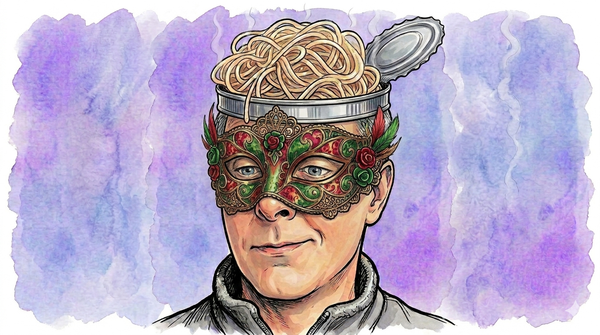
Because that's what my particular brain does with a whole exchange like that: instant conclusion, decision, rejection. Then forgotten and out of sight. Sinking down past the brain spaghetti where it doesn't resurface on its own.
Here are the simple reasons thirty years passed:
You can't challenge a conclusion you don't know is wrong. You can't question something you already believe is settled. And you can't search for a word you don't know exists.
Language isn't just how we describe reality. It's how we access it. "Neurodiversity" is a perfect example. I couldn't search for a word I'd never heard, so the idea of my wiring as a difference, not a defect, wasn't an option for me. As public understanding of autism has grown, more autistic adults are finally recognizing these patterns in themselves, because they've finally been given language that fits.[6]
I was living the definition my whole life. I just didn't have the word for it.
What I couldn't see at the time is that all of this made me fairly normal. Recent studies of autistic adults consistently find that the strongest protection against internalized stigma based on negative belief from societal stereotypes is self-understanding and the self-reflection which comes from diagnosis.[7]
For older adults who've spent decades masking, the combination of a narrow stereotype plus years of performing as someone else (called masking) shows up repeatedly as the primary reason they never recognized themselves in the first place.[8]
Which is exactly what my snap conclusion based on a negative belief prevented. I couldn't understand myself through a stereotype, especially one absorbed from a single movie instead of from actual autistic people.[3:1]
So the word autism entered my brain, and I saw a movie poster not a mirror. Now, the research has a clinical name for every step of that process. But myself? Ignorance is bliss, I guess?
For me, the typical answer to "why thirty years" includes the usual suspects: stubborn denial, ego protection, psychological resistance. The implication being that an emotionally healthier, stronger, more open Me would have accepted it sooner. Would that be me beating myself up, or is it really a moral judgment dressed up as psychology?
I think what actually happened was far easier to understand. The information wasn't available in a form I could use. The vocabulary word didn't exist yet. And masking, performing as a neurotypical well enough to hold a career, raise kids, and slogging away for years and finally earning an MBA, meant I was too busy and perpetually maxed out to give it much thought.[9]
And so thirty years passed.
What I’d Tell 1997-Steve
If I could get a message back to 1997-Steve walking out of that office, recommendation letter in hand, with his I’ve-done-all-I-can look on his face, I wouldn’t argue with him about whether he’s autistic.
1997-Steve isn’t ready, and arguing with Alarm Guy never works anyway.
I’d hand him a better movie poster.
I’d tell 1997-Steve that the image in his head is real, but it’s a single frame from a single film. The autism spectrum it’s supposed to represent is in actuality about as wide and diverse as the human race.
I’d share with him that the word he’s hearing, autism, is brand new. The science behind it is going to spend the next thirty years getting much bigger than that one movie. I’ll hand him a movie poster of the Ally Sheedy movie, Short Circuit, and suggest that 1997-Steve ask more questions and feed his own brain with research and information. “More input!” as Johnny 5, the robot in the movie would say.
I’d tell 1997-Steve that the very thing he’s so certain “isn’t him” is the same wiring that lets him build an information nest out of encyclopedias and chase a metaphor across four paragraphs at midnight, the same brain that finally beat the Calculus Minions by outflanking them. I’d tell him, plainly:
Your image of Rain Man, your stereotype of autism is all wrong. YOU are not wrong.
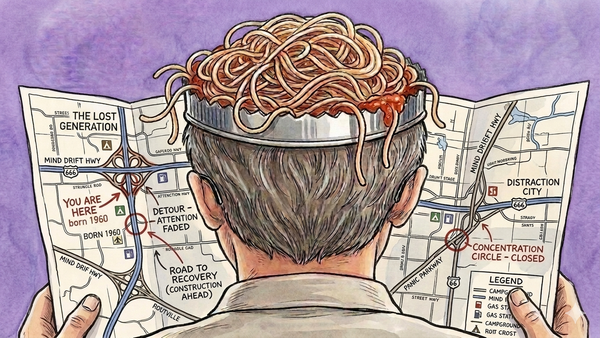
I also want 1997-Steve to understand this. The thirty years of life now ahead of him won’t represent a character flaw. 1997-Me doesn’t know it yet, but he’s one of an entire generation of autistic adults who will grow up before the vocabulary and the diagnostic framework exists in any usable form. Researchers will come to call us, The Lost Generation.[10]
Like every member of The Lost Generation, 1997-Steve was always wired this way. Formal diagnosis was forbidden, and he was left to piece together an explanation from the partial, wrong, or missing information that happened to be available.
And finally, over thirty years later, there IS A WORD...neurodiversity, landing in a hotel room in Hawaii. At sixty-five years old, with Sally asleep beside him, and a little AI-spinner turning on 2026-Steve’s screen.
Finally! Information arriving in a language that fits.
Researchers who study this call what happens next biographical illumination: the diagnosis doesn’t disrupt your life story, it illuminates it.[11]
Thirty years of life-experience and a trove of memory videos ready to rewatch and study through a new lens that actually works. The struggling student, the failed relationship patterns, the hyper-focused encyclopedia-nests, the sense of being out-of-step, the spaghetti-brain mystery of why my life never fit the world’s wiring…all of it now explained and understandable via the correct perspective.[12]
Cumulatively that’s a huge thing; not a small thing. It’s the book of my life, reopened. Readable. Understandable.
And then, because I know and finally understand 1997-Steve, I’d tell him the part we both actually find kind of funny...
That thirty years later, at sixty-five years old, lying in a Hawaiian hotel bed, we’re going to walk back through thirty years of our history and review the data. And the very first thing this stubborn, written expression disordered, idea-flooded, Spaghetti-brain of ours is going to want to do…
...is to write about it.
I’ve successfully kicked Rain Man out of my head. I’m no longer looking at his movie poster. My Alarm Guy just sat back down, and Manager Guy looked up from his donut.
Time to get to work!
Until next time.
Cheers,
— Steve
PS — Please practice grace and kindness …especially toward the “you” whom you may have just met.
Endnotes
The Mixed Space. “Rain Man Hasn’t Aged Well: Representation of Neurodiversity in the Media Since the Oscar-Winning Film.” The Mixed Space, January 2023. https://www.themixedspace.com/rain-man-hasnt-aged-well-representation-of-neurodiversity-in-the-media-since-the-oscar-winning-film/ ↩︎ ↩︎
Treffert, Darold A. “Savant Syndrome.” SSM Health Treffert Center, 2020. https://www.ssmhealth.com/treffert-center/conditions-treatments/savant-syndrome ↩︎ ↩︎ ↩︎
Hungerford, Catherine et al. “Autism, Stereotypes, and Stigma: The Impact of Media Representations.” Issues in Mental Health Nursing, Vol. 46, No. 3, 2025. https://www.tandfonline.com/doi/full/10.1080/01612840.2025.2456698 ↩︎ ↩︎
“The Evolution of ‘Autism’ as a Diagnosis, Explained.” The Transmitter (Spectrum News), August 2025. https://www.thetransmitter.org/spectrum/evolution-autism-diagnosis-explained/ ↩︎ ↩︎ ↩︎
Baumer, Nicole and Frueh, Julia. “What Is Neurodiversity?” Harvard Health Publishing, November 2021. https://www.health.harvard.edu/blog/what-is-neurodiversity-202111232645 ↩︎
Engelbrecht, Natalie. “The Rise of Late Autism Diagnoses.” Embrace Autism, February 2025. https://embrace-autism.com/the-rise-of-late-autism-diagnoses/ ↩︎
Huang, Yunhe et al. “‘I’ve Spent My Whole Life Striving to Be Normal’: Internalized Stigma and Perceived Impact of Diagnosis in Autistic Adults.” Autism in Adulthood, Vol. 5, No. 4, December 2023. DOI: 10.1089/aut.2022.0066. https://pubmed.ncbi.nlm.nih.gov/38116050/ ↩︎
Eliassen, A. Henry. “Stigma, Stereotypes, and Self-Disclosure: Disability and Empowerment in Older Adults on the Autism Spectrum.” The Gerontologist, Vol. 65, Issue 2, February 2025. https://academic.oup.com/gerontologist/article-abstract/65/2/gnae182/7926391 ↩︎
Hull, Laura et al. “‘Putting on My Best Normal’: Social Camouflaging in Adults with Autism Spectrum Conditions.” Journal of Autism and Developmental Disorders, Vol. 47, No. 8, 2017. https://pmc.ncbi.nlm.nih.gov/articles/PMC5509825/ ↩︎
Lai, Meng-Chuan and Baron-Cohen, Simon. “Identifying the Lost Generation of Adults with Autism Spectrum Conditions.” The Lancet Psychiatry, Vol. 2, No. 11, November 2015. https://pubmed.ncbi.nlm.nih.gov/26544750/ ↩︎
Tan, Catherine D. “‘I’m a Normal Autistic Person, Not an Abnormal Neurotypical’: Autism Spectrum Disorder Diagnosis as Biographical Illumination.” Social Science & Medicine, Vol. 197, 2018. DOI: 10.1016/j.socscimed.2017.12.008. https://doi.org/10.1016/j.socscimed.2017.12.008 ↩︎
Lilley, Rozanna et al. “‘Peas in a Pod’: Oral History Reflections on Autistic Identity in Family and Community by Late-Diagnosed Adults.” Journal of Autism and Developmental Disorders, 2023. https://pmc.ncbi.nlm.nih.gov/articles/PMC9986211/ ↩︎