I Finally Accepted My Autism Diagnosis of ~30 Years Ago
It happened in Hawaii.
HAWAII. Oahu. One of our favorite places. Sally and I were there in January 2026 for two weeks this time. One, two-week trip, stay longer, make it count.
It counted alright. I sure wasn't expecting a previous diagnosis from thirty years ago to find me on vacation. But it found me. I couldn't hide from it any more, and I could no longer deny it either.
The funny thing about it is that what I was hiding from wasn't really hidden to begin with. It was in plain sight, clear as could be. Things we convince ourselves are hidden and buried are still just so damn obvious and in plain sight to the ones we're closest to. The blindness of Pride? Mere self-survival? Maybe it's both...
Ko'Olina, Oahu. Ten o'clock or so. We're lying in bed. Sally's trying to sleep, but I cannot stop typing. I'd recently learned the word, neurodiversity.[1] I'd noticed it in something I was reading related to ADHD, dyscalculia[2] and written expression disorder[3] which I had been diagnosed with (all three) during the mid-1990s in graduate school.
After some deep research related to neurodiversity, my brain had been spinning things around in my head like the teal colored spinning asterisk Perplexity AI shows when it's thinking. Neurodiversity things related to autism and autistic cognition...like twice exceptional, 2e,[4] and masking...[5]
I got to wondering...
That incessantly spinning Perplexity asterisk-throbber thingie got me wondering: Do actual clinical, research-supported explanations exist for how my brain works? Three specific things related to how my brain has worked that I've known about since I was a little boy.
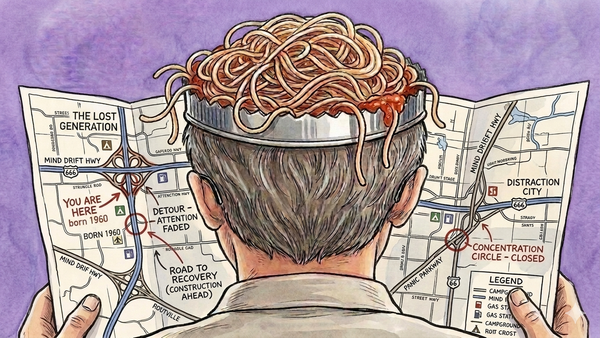
My "goofy brain," I've always referred to it. I've noticed, joked about, described in fine detail, but never had the precise labels or understanding for the what or why of my goofy brain.
That night in Hawaii I finally tried to pin them down. Just write three quick paragraphs, written in the first person, about exactly what happens in my brain in each of these three distinct scenarios. Easy-peasy. Straightforward enough, right?
It was not at all straightforward. No easy-peasy for me with writing. Not ever. For me, writing is like what I imagine a human birthing an elephant would be. (Or maybe passing a kidney stone is more appropriate? No keep the elephant metaphor. I've birthed those writing-elephants...) I have written expression disorder.
Getting words from brain to page is sometimes like...well, that's another post. But I got there. Three written paragraphs. Three scenarios. I typed them up:
"Perplexity: I'm trying to figure out how to describe the memory and recall challenges I've exhibited since i was a young boy. I describe the symptoms as:
(1) having initial "cognitive blanks." For example, it's like I'm missing the index file for the contents of my brain/memory. The knowledge and memories are in there, it just takes me a long while to find and extract the information I need out of my brain. There are accommodations I've developed to counter this challenge.
(2) Other times, knowledge which I know I have in my brain is just not there. For example, after a college or grad-school class--in which I was fully involved in discussion and felt complete mastery of the topic--I would get home a couple of hours later and open my notes and the class textbook, and my brain would react as if I had never before seen or read the information; sometimes i even wondered if my hand-writing in my notebook was my own writing; i could recognize my own handwriting, but the information written on the page seemed foreign to me.
(3) another example is when playing a card game with family. After hours of playing the same card game one evening, the next evening with the same card game, at first I couldn't remember the rules of the game--such as how many cards to deal each player; it was only after playing a hand or two of the same game, that my life-long familiarity with the game came back to the forefront of my mind like regaining the awareness and rules of the game. What am i describing here? What is it called?"
And I pasted them into Perplexity.
Then I watched the little Perplexity spinner icon do its thing.
And what came back stopped me cold.
Each one of those three scenarios, things I'd been living with and puzzling over since childhood, came back to me with a name. A clinical name. Research behind it. Studies. Documentation. Not vague, not fuzzy but, precise and specific and real. One of them, the scenario I called my brain's missing index file: I know something is in there, filed away, but the retrieval path just…isn't there. I've joked about that my whole life.
Turned out it wasn't a joke. It's a documented feature of how certain brains are wired.[6] And the other two scenarios? Same thing. Named. Research supported. Explained. And the clinical data, the terms, the cognitive diagnoses and the vocabulary...all 100% fit and explained...Me.
I'm lying in bed in Hawaii, keeping Sally awake, and I'm reading my own inner life described back to me in clinical language for the first time at 65 years old.
Stunning is the only word I've got for it. Stunning and affirming and something else I'm still not sure I have the right word for something like the feeling people describe when they find their birth parents. That sudden sense of: oh. This is where I come from. This is why. I couldn't help but see that other elephant. The one that had always been in the room.
Here's the thing. This wasn't actually new information.
I had been told. Flat out, no ambiguity that I was autistic. Told by a clinician. Back in the mid-1990s. Nearly 30 years ago. I heard it, I tucked it somewhere in the back of my head next to things I was not going to deal with, and I walked out of that office, and I didn't go back.
Thirty years.
That's a long time to carry around something you're not ready to look at.
What changed in Hawaii wasn't the diagnosis. What changed was me. Something in those three paragraphs I typed, something in watching Perplexity answer back what I'd only ever described in jokes and workarounds and frustrated late-night homework sessions. Something finally clicked into place. The fear I'd been carrying around that word, autism, just…wasn't there anymore. What was there instead was curiosity. Relief. And this almost embarrassing sense of: of course. Obviously. How did I not see this sooner?
(I now know why. That's also another post.)
This is the first in a series of posts about that 30-year gap. What caused it, what it cost, what the three scenarios actually are and what science calls them. What it means to be 65 years old and just now fluent in your own wiring.
If any part of this sounds familiar. If you're in your 50s or 60s or older and something in here is landing a little too close to home, I'm writing this for you too.
We have a name now. Several names actually. And none of them are what I was afraid of for more than thirty years of denial.
If you want to watch a giant, eighth-grade string-bean accidentally win his first math battle, Part 2 to my Intro Series is here: Letters from a Dyscalculia Veteran of the Calculus Wars.
More soon,
— Steve
PS — Please practice grace and kindness...and toward yourself!
Neurodiversity is the concept that natural variation in human brain function — encompassing differences in learning, attention, and social processing, including autism spectrum disorder, ADHD, and specific learning disabilities — represents normal neurological diversity rather than defect. The term emerged from autistic self-advocacy communities in the 1990s and has since been adopted in clinical and research contexts. Harvard Health Publishing. "What is neurodiversity?" Harvard Health Blog. November 23, 2021. https://www.health.harvard.edu/blog/what-is-neurodiversity-202111232645 ↩︎
Dyscalculia (classified under DSM-5 as Specific Learning Disorder with impairment in mathematics) is a developmental learning disability characterized by persistent difficulty with arithmetic and numerical concepts, present even in individuals with otherwise typical intelligence and adequate schooling. Its prevalence in the school-age population is estimated at 3–7%. Kucian, K., and M. von Aster. "The Diagnosis and Treatment of Dyscalculia." Deutsches Ärzteblatt International 116, no. 7 (2019): 107–114. https://pmc.ncbi.nlm.nih.gov/articles/PMC6440373/ ↩︎
Disorder of written expression was listed as a discrete diagnostic category under DSM-IV; in 2013 the DSM-5 folded it into the broader category of Specific Learning Disorder with impairment in written expression. Either way, the diagnosis describes writing skills that fall substantially below expectations for a person's chronological age and education level and that meaningfully interfere with academic or daily-life tasks. Because all three of the author's diagnoses were made in the mid-1990s, they predate the DSM-5 reclassification and reflect DSM-IV terminology. Grohol, John M., PsyD. "Disorder of Written Expression Symptoms." PsychCentral. May 17, 2016. https://psychcentral.com/disorders/disorder-of-written-expression-symptoms ↩︎
Twice exceptional (2e) describes intellectually gifted individuals who also have one or more learning disabilities or neurodevelopmental differences — including autism spectrum disorder, ADHD, or specific learning disabilities. The dual profile frequently causes giftedness and disability to mask each other, resulting in individuals who may go unidentified and underserved on both dimensions. Dlugosz, Mark. "Twice Exceptional: Definition, Characteristics & Identification." Davidson Institute for Talent Development. May 31, 2021 (updated April 3, 2025). https://www.davidsongifted.org/gifted-blog/twice-exceptional-definition-characteristics-identification/ ↩︎
Masking (also termed camouflaging or social camouflaging in the research literature) refers to the behavioral and cognitive strategies autistic individuals use to suppress or hide their autistic characteristics in order to appear neurotypical in social situations. Research consistently links prolonged masking to elevated stress, burnout, delayed diagnosis, and adverse mental health outcomes. "Masking, Social Context and Perceived Stress in Autistic Adults: An Ecological Momentary Assessment Study." PMC Open Access. 2025. https://pmc.ncbi.nlm.nih.gov/articles/PMC12618727/ ↩︎
Differences in memory encoding and retrieval are among the best-documented cognitive features of autistic brains. Peer-reviewed neuroimaging research has demonstrated that autistic adults show significantly reduced hippocampal functional connectivity during episodic memory retrieval, along with distinct cognitive pathways used to access stored knowledge — patterns consistent with the self-described "missing index file" and the related retrieval experiences described here. Cooper, Rose A., Franziska R. Richter, Paul M. Bays, Kate C. Plaisted-Grant, Simon Baron-Cohen, and Jon S. Simons. "Reduced Hippocampal Functional Connectivity During Episodic Memory Retrieval in Autism." Cerebral Cortex 27, no. 2 (2017): 888–902. https://pmc.ncbi.nlm.nih.gov/articles/PMC5390398/ See also: "Relational Memory Weakness in Autism Despite the Use of a Controlled Encoding Task." Frontiers in Psychology 14 (2023). https://www.frontiersin.org/journals/psychology/articles/10.3389/fpsyg.2023.1210259/full ↩︎