Executive Function Explained
In my autistic & ADHD (AuDHD) brain, things can be a tad bit wonky...
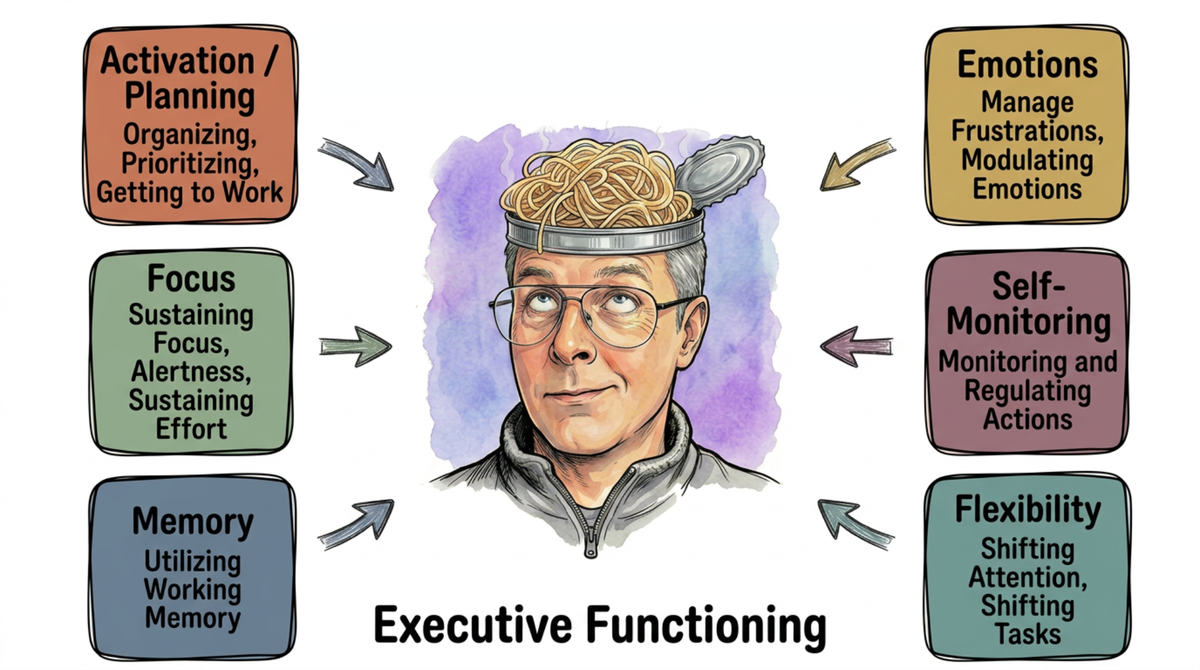
Executive function is the brain’s coordination system for doing life on purpose: setting a goal, holding it in mind, resisting competing impulses when the situation provides optional choices. In autistic and ADHD (AuDHD) brains, the three components technically exist, but they tend to be glitchy, easily overloaded, and depend a lot on what is happening around us in the moment.
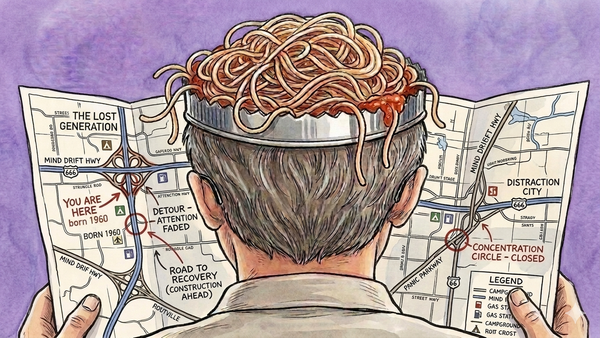
My own goofy, spaghetti-brain can seem brilliant one moment and stalled-out blank the next.
People like to describe executive function as “the brain’s management system.” I picture it more like a tiny, overworked stage manager guy in my head trying to wrangle props, actors, lighting cues, chainsaws, random bowling balls and chicken eggs that keep rolling across the stage.
Executive function is the set of mental processes that lets us plan, start, and finish things on purpose instead of just reacting to whatever is the loudest shiny. (Ha!)
Researchers usually lump the core pieces into three big buckets: working memory, inhibitory control, and cognitive flexibility (set shifting). For an AuDHD brain like mine, all three are running the theater, but they are running the show with glitchy lighting, in a noisy theater...and someone keeps rearranging the furniture in the dark.
Working Memory: My Fuzzy Mental Whiteboard
Working memory is the brain’s “right now” workspace. It is what lets you hold a few steps in mind while you carry them out, track where you are in a conversation, or remember what you walked into the kitchen to do...in theory, of course.
In practice, my working memory feels like a whiteboard that keeps getting wiped every time someone coughs, my body hurts, or that awesome squirrel does something really cool outside the window.
My everyday realities include:
- I open my email to “answer that one quick email,” then see three other things, click one, get annoyed by a notification, and suddenly I am reading an article about, The Squirrels of Springfield, USA. The original “quick email” fell off my dry-erase board completely.
- I stand up to refill my coffee and get a tube of oil paint, then stop in the hallway. My brain has dropped both tasks and is now wondering if we fed our pet bilby this morning.
- Mid-conversation, I know I had a thought I wanted to add, but by the time Sally finishes her sentence (and, go figure, I was actually listening. Yay.) my thought has disappeared. My brain kindly returns the same lost thought...typically, of course, seven hours later at 2:30 a.m. while I'm trying to sleep.
My long-term memory, especially for patterns, conversations, and rabbit-hole topics, is fine. Sometimes it is ridiculously fine. Ironically, it's the, “three things at once in the present moment,” short-term memory that goes all wonky on me just when I need it to work right...like during the mild-interrogation questions while crossing the US/Canadian border in the car...
Inhibitory Control: The Missing Brake Pedal
Inhibitory control is the ability to not do the first thing that pops into your head. It is the filter and mental brake pedal combo you use for pausing before acting, for ignoring distractions, and down-regulating an emotional surge long enough to allow responding instead of just reacting.
For me, this is where my ADHD wiring likes to instantly react while my autistic wiring mutters, “this violates protocol.” The result is a kind of cognitive ping-pong where my filter and brake pedal sometimes work great and sometimes not at all.
A few real-life scenes:
- I sit down at the laptop to write. A small part of my brain whispers “what if we just check one thing real quick.” Before I can even decide, my fingers have already opened a new tab. The impulse acted faster than my intention to resist.
- In a conversation, I blurt out my thought, because if I wait, I will lose the thought. My need to share the idea before it’s vanished, outruns my social filter and brake pedal’s goal to be polite and socially respectful.
- A plan changes at the last minute, or a piece of tech misbehaves, and my emotional volume knob jumps from 2 to 8 with very little warning. The feeling hits first; the “reasonable response” arrives on the scene way too late to be effective.
For me, inhibitory control is less “I have no self-control” and more “my filters and brakes work beautifully in some lanes and are downright squishy-brakes in others." This is especially true when pain, noise, or environment are already chewing-up my brain's bandwidth.”
Cognitive Flexibility: Stuck, Slippery, or Both
Cognitive flexibility, or set shifting, is the ability to switch tasks, rules, or mental gears without seizing up. It's what lets you stop doing one thing, re-orient, and start something else without losing your place or your mind.
In my AuDHD brain, set shifting sits right at the collision point between “autistic need for sameness” and “ADHD novelty-seeking Tigger.”
How that plays out day to day:
- If I am in hyperfocus on a painting or an essay, getting interrupted feels like someone raking their nails across a chalk board. Externally, it’s the default sound of a text alert. Internally, it’s like chewing on aluminum foil.
- If a plan or environment changes unexpectedly, my mind freezes while it rebuilds the internal map. I either look calm or irritable on the outside, but internally I’m temporarily frozen and staring at the spinning beach ball of doom.
- On the flip side, if a task becomes repetitive and unstimulating, my ADHD wiring starts looking for any excuse to escape it. So I can get stuck and slippery at the same time, which is both unable to let go of what I expected, while also unable to stay fully engaged with what’s actually happening.
Cognitive flexibility is not just about being “flexible.” It is about managing the cost of set switching, and in my system that cost is high. Every gear change has a toll, and if I do too many in a row, the toll booth threatens to shut down for the day.
These Three Gang Up on Me
Working memory, inhibitory control, and cognitive flexibility are technically separate, but in real life they operate as a single messy bundle.
On a typical day:
- Pain, noise, or emotional load eat up working memory, so there is less room left to hold tasks in mind.
- With the mental whiteboard already crowded, distractions slip past my brakes more easily, and my attention ricochets from tab to tab.
- Every time I switch gears, my system pays a cost, so I cling harder to whatever groove I can find, even when I know I need to stop for food, rest, or basic life tasks.
The same wiring also gives me hyper-focus zones where time disappears, pattern recognition that can border on spooky, and a kind of stubborn creativity that keeps trying to find another solution when the standard processes fail. The stage manager might be overwhelmed, but the stories, colors, and ideas on that stage are very, very alive.
OK, So What Actually Helps?
Executive function is a fragile, context-sensitive brain system that does better with a support framework. For my goofy, spaghetti-brain, the most helpful supports do three things:
- they take pressure off working memory;
- they add guardrails for inhibitory control;
- and they make set-shifting (cognitive flexibility), or jumping between tasks and/or thought-processes, less brutal.
My working memory’s ice cream cone melts fast, so my rule is to never trust my head to hold anything important by itself.
What this looks like for writing, art, and daily life:
My Visual Memory-Cues "Trigger" My Working Memory
- I keep a scratchpad I euphemistically refer to as, “Brain Spaghetti Visual Edition” next to me. Any task or idea gets written there immediately instead of: (A) being distracted and chasing it; (B) trying to remember it, and (C) inevitably forgetting it.
- Small visual reminder restart clues instead of trying to remember the whole process. I’m a visually oriented person to the extreme of the phrase, “out-of-sight, out-of-mind.” So, I have different tricks and set-up routines I try to do when I’m temporarily stopping work on an ongoing process.
- For example, before I shut down writing for the night, or working on an art project, I might leave myself a quick written list bullet-points to give me a “restart point” when I resume the project again.
- Frequently, I’ll leave a clean paintbrush on my palette pointing at one blob of oil paint as a reminder to myself of which hue I intended to work with next when I resume my work in process.
- Often, I’ll snap a photo of a project and write a few on-screen notes on the photo, print it, and leave the annotated photo next to the project. This habit is invaluable when I find myself returning to a project days or weeks after my last work session. A scenario where I have literally no chance of remembering where I’d left off.
- My series of small, visual prompts are reminders which hopefully trigger my brain into its recall of bigger-picture context and related workflows. They help focus me as I shift gears into production mode when I’m restarting an ongoing creative project with productive intentions.
Externalizing like this can feel like extra work for merely simple tasks, but research keeps coming back to the same point that visual schedules, lists, and written routines reduce working-memory demand and make life easier for autistic and ADHD adults.
For me, “supporting working memory” mostly means moving as much as possible out of my brain and into the environment, so my limited short-term or working memory can be used for the way more interesting stuff.
Like shiny things ...and birds ...and squirrels.
Supporting Inhibitory Control, Digital Discipline
My impulse control is very visual and relative to the context of my surroundings. I have to assume willpower will be unreliable. I design my environment to help Future-Steve.
Things that actually help me to hit the brakes:
-
One single “mode” at a time
If I am in “writing mode,” I close my browser and everything that is not needed for the piece and keep only one iA Writer document visible on my screen. My brain is much less likely to go fishing if it can’t see the 'Net. I also am likely to put in 3M foam-earplugs AND wear my Bose noise-cancellation headset, so I’m less vulnerable to creative-death-by-distraction caused by shiny-noise-things. -
Pre-decided “if-then” rules
I try to follow some basic rules I make-up in advance, so I’m not inventing self-control on the fly. I’m just following a script. For example, if I feel the urge to check-out a new idea while writing, I try to write it down on my Brain-Spaghetti Visual Edition pad. It’s a basic new-browser-tab avoidance system. -
Rule of "One"
I have one pad of paper and one app for lists, ideas, to-do’s, etc. I have one writing software/app (iA Writer) on my Mac and devices which updates all files/folders via one cloud-based file library which serves as the central repository for my entire library of folders and files accessed from all of my apps and software. I want to avoid ending up with a bunch of different sources for recording ideas, and I want to have one library of all my work and archives. A little bit of habitual, digital organizational discipline goes a long way. If I'm not careful, it's easy to end up spending a poop-load of time organizing different organization systems. The classic time-suck and ADHD-trap we want to avoid.
And btw, the more stressed, sleep-deprived, or pained I am, the worse my brakes work. That’s not failure. It is literally how executive function responds to strain for any person...whether you're neurotypical or neurodivergent.
It means that rest, pain management, and realistic expectations are essential parts of the process, not optional luxuries.
For me, inhibitory support is less about nailing down the hatches and more about pre-building familiar, comfortable habits and routines to slide into when I am tired, overstimulated, or tempted to chase all the squirrels, with all their shiny things, all at once.
Hopefully, my research and the process of sharing what I’ve learned here, will give my long-term memory a sense of familiarity with the topic and concepts.
And tomorrow, when Future-Steve is unlikely to retain short-term memory of the specific details Present-Steve is writing here now in this post full of heavy, clinical stuff, I can return here to Miswired.me and reread what Past-Steve wrote here...
Until then,
— Steve
PS – Maybe give yourself some time...especially if this is all new, right?

For Further Reading...
Cleveland Clinic. "Executive Function: What It Is, How To Improve & Types." Cleveland Clinic, March 2024. https://my.clevelandclinic.org/health/articles/executive-function
Miyake, Akira et al. "Executive Functions." PMC / National Institutes of Health, September 2012. https://pmc.ncbi.nlm.nih.gov/articles/PMC4084861/
Understood Team. "The 3 Areas of Executive Function." Understood.org, October 2019. https://www.understood.org/en/articles/types-of-executive-function-skills
Diamond, Adele. "Executive Functions." PubMed / National Institutes of Health, 2013. https://pubmed.ncbi.nlm.nih.gov/23020641/
Children's Hospital of Philadelphia. "What Are Executive Functions and How Are They Related to ADHD?" CHOP, April 2023. https://www.chop.edu/sites/default/files/adhd-exec-5-what-are-efs-and-how-are-they-related-to-adhd.pdf
Myndset Therapeutics. "Working Memory vs. Long-Term Memory: An AuDHD Perspective." Myndset Therapeutics, March 2025. https://www.myndset-therapeutics.com/post/working-memory-vs-long-term-memory-an-audhd-perspective
Foothills Academy. "What is Inhibitory Control?" Foothills Academy, May 2022. https://www.foothillsacademy.org/community/articles/inhibitory-control-adhd
Leafwing Center. "Working Memory and Autism." Leafwing Center, 2025. https://leafwingcenter.org/working-memory-and-autism/
PMC / National Institutes of Health. "Inhibitory Control and Information Processing in ADHD." PMC, 2019. https://pmc.ncbi.nlm.nih.gov/articles/PMC6698914/
Wikipedia contributors. "Executive Functions." Wikipedia. https://en.wikipedia.org/wiki/Executive_functions
Carmen. "Cognitive Flexibility and Rigidity in AuDHD." Authentically ADHD, October 2025. https://carmenauthenticallyadhd.substack.com/p/cognitive-flexibility-and-rigidity
UCSF Memory and Aging Center. "Executive Functions." University of California San Francisco. https://memory.ucsf.edu/brain-health/executive-functions
Neurodivergent Insights. "Working Memory." Neurodivergent Insights, 2025. https://neurodivergentinsights.com/glossary/working-memory/
PMC / National Institutes of Health. "Do Children with Attention-Deficit/Hyperactivity Disorder Show Deficits in Set-Shifting?" PMC, April 2019. https://pmc.ncbi.nlm.nih.gov/articles/PMC6668027/
Life Skills Advocate. "AuDHD and Executive Function: What Happens When Autism and ADHD Collide." Life Skills Advocate, March 2026. https://lifeskillsadvocate.com/blog/audhd-executive-function-daily-life/
ADDitude Magazine. "AuDHD: Stories of Life with Autism and ADHD." ADDitude Magazine, March 2024. https://www.additudemag.com/audhd-autism-adhd-experience/
Autism.org. "Executive Function and Autism." Autism.org, November 2021. https://autism.org/exeuctive-function-autism/
Embrace Autism. "Executive Challenges in Autism and ADHD." Embrace Autism, September 2024. https://embrace-autism.com/executive-challenges-in-autism-and-adhd/
Academics West. "Working Memory and Executive Functioning: What Parents Need to Know." Academics West, January 2026. https://academicswest.com/working-memory-and-executive-functioning-what-parents-need-to-know/
Landmark Outreach. "What is Executive Function?" Landmark Outreach, March 2026. https://www.landmarkoutreach.org/strategies/executive-function-overview/
Understood Team. "What is Executive Function?" Understood.org, August 2019. https://www.understood.org/en/articles/what-is-executive-function
Meristem. "7 Executive Function Strategies for Autism That Actually Work." Meristem, November 2025. https://meristem.pro/independent-living/7-executive-function-strategies-for-autism-that-actually-work/
A Day in Our Shoes. "100 Executive Function Accommodations for Adults." A Day in Our Shoes, January 2026. https://adayinourshoes.com/adult-executive-function-accommodations/
Alumacare. "Effective Methods for Teaching Writing to Students with Autism." Alumacare, August 2024. https://www.alumacare.com/blog/teaching-writing-to-students-with-autism
Autism Parenting Magazine. "7 Tips for Teaching Writing Skills to Autistic Students." Autism Parenting Magazine, May 2024. https://www.autismparentingmagazine.com/teaching-writing-skills-autism/
Diverge Psychotherapy. "Managing Executive Function Challenges in ADHD and Autism." Diverge Psychotherapy, October 2023. https://www.divergepsychotherapy.com/blog/managing-executive-function-challenges-in-adhd-and-autism
Life Skills Advocate. "Improve Executive Function in Adults: A Realistic Guide." Life Skills Advocate, April 2026. https://lifeskillsadvocate.com/blog/improve-executive-function-in-adults/
PMC / National Institutes of Health. "Executive Function in Autism: Association with ADHD and Symptom Severity." PMC, January 2021. https://pmc.ncbi.nlm.nih.gov/articles/PMC8322145/
dr7.ai. "Executive Function Issues: Autism vs ADHD." dr7.ai, October 2025. https://dr7.ai/blog/health/executive-function-issues-autism-vs-adhd/
CHADD. "Using Context to Build and Enhance Executive Functioning." CHADD, March 2026. https://chadd.org/adhd-weekly/using-context-to-build-and-enhance-executive-functioning-2/
PMC / National Institutes of Health. "Executive Function Deficits in Attention-Deficit/Hyperactivity Disorder." PMC, August 2024. https://pmc.ncbi.nlm.nih.gov/articles/PMC11485171/
Harvard University Center on the Developing Child. "A Guide to Executive Function." Harvard University, April 2026. https://developingchild.harvard.edu/resource-guides/guide-executive-function/