Spoon Theory Explained
What We Wish You Could See from the Inside
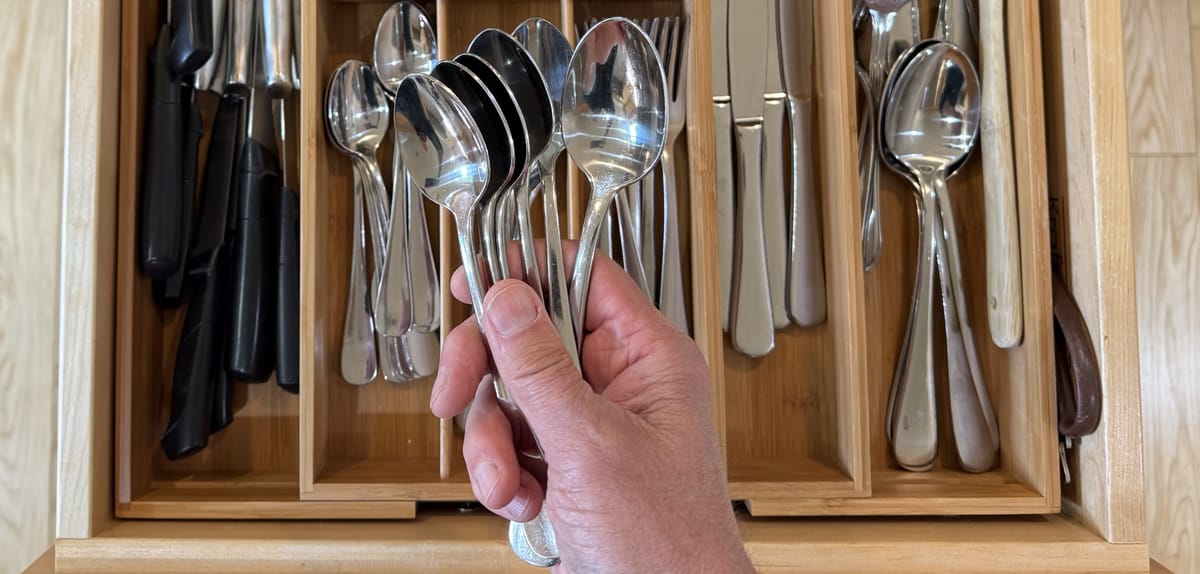
Most people wake up in the morning and reach into an imaginary silverware drawer stocked with an infinite supply of spoons. One spoon to shower, another to make coffee, a third to get dressed. They barely notice the drawer getting empty, because it never does. The spoons automatically resupply overnight, and most people never have to think about it.
My spoon drawer has a finite supply. And there’s no sense checking the dishwasher for more spoons. All the spoons I get for today are already in the drawer.
On a decent day, I might start with a dozen spoons. On a rough day, or the morning after I pushed too hard the day before, I might find seven or eight spoons when I reach in. During a flare week, sometimes just five. The number is never guaranteed, and I don’t get to negotiate it.
Some perspective: Spoon theory is not a metaphor exclusive to chronic illness or mental health, and my personal spoon scenario is not uniquely difficult. Case in point: every woman who has ever lived through a brutal monthly cycle, or managed the grinding pain of endometriosis, already understands the idea of limited spoons. You may have helped a loved one white-knuckle through it, which is how I gained a sense of what it’s like.
I’m hoping to describe the spoon-math as it works in my particular body on my particular days. Maybe it will make sense and help someone gain new insights for their daily life.
The Origin of Spoon Theory
In 2003, writer and lupus patient Christine Miserandino was having a late dinner when her best friend asked her what it actually felt like to be sick. Miserandino grabbed every spoon off their table and from neighboring tables, handed them to her friend, and told her: this is your energy for today. Count them.
Then she started taking spoons away, one by one, for every ordinary thing her friend said she would do that day. Getting out of bed. Taking a shower. Getting dressed. Making breakfast.
The pile disappeared fast. Her friend had not even made it to work yet.
That improvised dinner metaphor became what is now widely known as Spoon Theory: a way of explaining the finite daily energy supply that people with chronic illness, disability, or neurodivergence navigate every single day.
When I first heard someone referring to themselves as a “Spoonie,” I checked it out. The extended metaphor seemed patently obvious to me, until I read Ms. Miserandino’s quietly affecting account at dinner with her best friend. I have new-found respect and appreciation for “spoon theory.”
Each person’s spoon drawer and daily spoon supply are unique and relevant to their individual lived reality.
My Spoon Drawer Starts Short and Empties Fast
For most people, fatigue is temporary. Sleep fixes it. A chill weekend can fix all kinds of things. Those restorative fixes, and many others, aren’t as reliable for me. My spoon drawer starts with a limited spoon supply and empties faster. My body and my brain are running overhead costs that never take a break. There are three distinct reasons for the continuous energy burn. The three run simultaneously, and they don’t take turns. They make each other worse.
First, the Pain Tax: I live with systemic enthesitis, a defining feature of an inflammatory disease called spondyloarthropathy, or SpA. Enthesitis is chronic inflammation of the entheses (plural of enthesis), which are the load-bearing structures where every tendon and ligament in the body attaches to bone. The inflammation costs flexibility by causing calcium to accumulate, over time, at those attachment sites. Because calcium builds up slowly, doctors concluded that this inflammatory process has been active since I was a young boy.
Fibromyalgia lives with me too. It’s a disorder of the central nervous system, not the tissues themselves. The mechanism is called central sensitization: the brain and spinal cord essentially get stuck in a high-alert state of overreaction to actual or imaginary stimuli. By “imaginary,” it means that pain signals can activate and fire when there is little or no physical reason to do so, but the pain is very real to our body.
Fibromyalgia also tends to bring along a full entourage of its joy-sucking henchmen: disrupted sleep, cognitive fog, fatigue that doesn't respond to rest (or chill weekends), and heightened sensitivity to light, sound, and smell. On its own, that would be a full-time problem. Layered on top of systemic enthesitis, it means the magnified pain tax is real and takes its toll.
Pain is not passive. It is work for our bodies. Every hour the body spends managing inflammation and processing amplified or fake pain-signals costs spoons. Whether I’ve been overactive the day before with physical exertion, or because my body spent the night not fully resting but instead processing stiffness and pain, I can wake up already multiple spoons behind for the day. This isn’t an exaggeration, and it’s not a bad attitude. It's physiology.
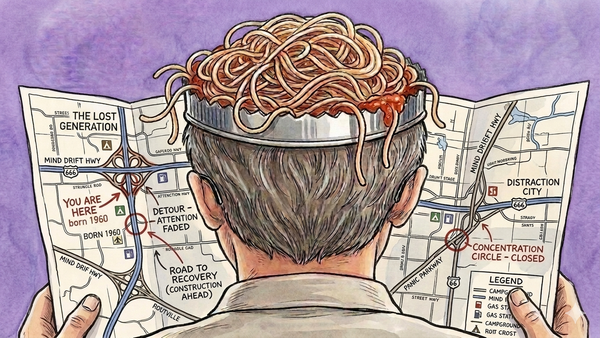
Second, the Sensory and Executive Processing Tax: I am autistic and have ADHD, a combination sometimes called AuDHD. My brain lacks the automatic filter that sorts "important input" from "background noise." Everything gets processed consciously and effortfully: the hum of the refrigerator, the texture of my shirt, the tone of a voice, the flicker of fluorescent lighting, the thirty-seven things on today’s list I’m trying to remember.
Neurotypical brains handle most of that filtering on autopilot, no spoons, essentially for free. My brain charges me spoons for all of it. Every conversation, every transition between tasks, every sound or other sensory stimulus within my surroundings subconsciously drains my energy, steals spoons, from my limited supply in the virtual silverware drawer.
Third, the Masking Tax: The third cost that is harder to see from the outside: masking, or the effort of performing, "normal." Autistic people typically have to learn to suppress their natural behaviors, learn to mirror social cues, and manage the gap between how we process the world and how the world expects us to act, aka normal. That survival performance, called masking, is exhausting in a way that does not show on my face.
On a day when I am out in the world, moving through social situations, presenting myself as composed and capable, I may look fine. But the spoon drawer is getting lighter and lighter with the effort to look “fine” with every passing hour.
The Three Conditions as a Compounding Loop
The physical and cognitive conditions described do not simply add their costs together. Each condition actually increases the overhead cost of managing the other two, so the total always equals more than the sum of the three individual parts.
Pain degrades the cognitive resources masking requires. Fibromyalgia is well-documented to cause measurable impairments in concentration, working memory, and processing speed, sometimes called fibro fog. Masking causes its own drain on the same resources. So when pain is high, masking’s spoon consumption costs are more expensive at the same time the brain has fewer resources to fund it.
Masking makes the pain worse. Sustained muscle tension from suppressing physical responses, such as hiding lower back and leg cramping, shoulder bracing, the forced stillness of keeping a straight face while trying to look composed, all create tension which directly aggravates enthesitis attachment points and also works to overfeed fibromyalgia's central sensitization. The effort of fighting the pain and performing “normal” or “I'm fine" physically tightens the very structures that are already inflamed.
AuDHD sensory processing and fibromyalgia's central sensitization overlap. Both conditions involve a nervous system that cannot properly regulate sensory input. Fibromyalgia amplifies pain and sensory signals centrally. AuDHD processes those already-amplified signals without the automatic dampening filter most people rely on. The same crowded, noisy environment that costs a neurotypical person one spoon can cost me two or three. I’m processing the same loud signal in full band-width mode, multiple times, every time.
The Empty Drawer and the Borrowing Problem
Here is the part that tends to surprise people.
When the drawer runs out, there is no reserve. But sometimes I spend spoons I don’t actually have. A deadline is approaching, a social commitment can’t be cancelled, or an unexpected obligation lands in my lap. I borrow spoons from my tomorrow supply.
Today’s energy debt is paid in pain and exhaustion which carries over into tomorrow, when I might start with only five spoons left instead of ten. If I borrow again, it compounds. This is how a fibromyalgia flare starts, by merely pushing through it. Once a flare is underway, getting back to a ten-spoon morning can take days or weeks.
This is why "just push through it" is not useful advice. And when I do that, which is way too often, I really tick myself off. Why? Because I know better. Pushing through it is real borrowing with real interest, and I am the one who pays the debt interest penalty when I borrow from myself.
And I do it anyway...ugh.
I Should Budget and Plan, But Tend to Fail
Counting spoons is not self-pity. It is budgeting. I understand the theory. But I blow up the spoons/energy budget plan more often than not these days. I’ve been diagnosed with fibromyalgia for all of seven weeks as I write this, so hopefully I get smarter about it all soon. I want to get smarter about the reality of it...
I want to think about my day the way someone on a fixed-income thinks about money: knowing what things cost before I commit, keeping something in reserve for the unexpected, and not spending everything just because I feel okay at 10:00 a.m.
But right now, I’m still begrudgingly accepting the fibromyalgia news. For sure, the clinical research and knowledge fits...and knowing about my new fibromyalgia diagnosis explains literally everything...
I’m just not ready to accept my official non-Superman, limited-energy status. I like younger-Steve, and I’d like him back.
On rare days the drawer surprises me with a few bonus spoons. Woohoo. I grab ‘em and use ‘em with thankful intention. Many days my supply comes up short, and I have to make hard choices about what won't get done today.
Often, I borrow too much from tomorrow’s and the next-day’s spoon supplies, and that’s on me. I own it. It’s my mismanagement.
Spoon theory. It makes complete sense to me. Now, I just need to apply and use the theory. I’ll work on that tomorrow...
Until next time,
—Steve
PS — Let's try to go easier on ourselves? ...myself included.

For Further Reading
The unpredictable and non-negotiable nature of daily energy limits in chronic illness is a core element of Spoon Theory as originally framed. Christine Miserandino. "The Spoon Theory." Reproduced by Lymphoma Action, May 2020. https://lymphoma-action.org.uk/sites/default/files/media/documents/2020-05/Spoon theory by Christine Miserandino.pdf
"What Is the Spoon Theory Metaphor for Chronic Illness?" Cleveland Clinic, November 15, 2021. https://health.clevelandclinic.org/spoon-theory-chronic-illness
Irene Roth. "How the Spoon Theory Can Help Fibromates Pace Themselves." Fibro Support Network, April 21, 2025. https://fibrosupportnetwork.ca/2025/04/21/how-the-spoon-theory-can-help-fibromates-pace-themselves-by-irene-roth/
Praxis Psychologie Berlin. "AuDHD and Spoon Theory: More Energy in Everyday Life with ADHD and Autism." Praxis Psychologie Berlin, April 6, 2026. https://www.praxis-psychologie-berlin.de/en/wikiblog-english/articles/audhd-spoon-theory-more-energy-in-everyday-life-with-adhd-and-autism
Neurodivergent Insights. "Spoon Theory for Autism and ADHD." Neurodivergent Insights, July 12, 2022. https://neurodivergentinsights.com/the-neurodivergent-spoon-drawer-spoon-theory-for-adhders-and-autists/
Mental Health Matters. "Spoon Theory: Understanding Energy for Neurodivergent People." MHM, April 6, 2026. https://www.mhm.org.uk/spoon-theory-understanding-energy-for-neurodivergent-people
Luca Patti, et al. "Cognitive Impairments in Fibromyalgia Syndrome." Frontiers in Pharmacology 9 (March 21, 2018). https://pmc.ncbi.nlm.nih.gov/articles/PMC5874325/
ADDitude Magazine. "Masking with ADHD: Hiding Symptoms is Exhausting." ADDitude, May 7, 2025. https://www.additudemag.com/masking-with-adhd-hiding-symptoms/
Emotions Therapy Calgary. "ADHD Masking: The Hidden RSD Connection." Emotions Therapy Calgary, 2025. https://www.emotionstherapycalgary.ca/blog-therapy-calgary-emotions-clinic/adhd-masking
Anchor Health Counseling. "How ADHD Masking Leads to Burnout and How to Break the Cycle." Anchor Health Counseling, March 8, 2026. https://anchorhealthcounseling.com/how-adhd-masking-leads-to-burnout-and-how-to-break-the-cycle/
Mind and Body Works. "Spoon Theory and Autism." Mind and Body Works, April 29, 2026. https://mindandbodyworks.com/spoon-theory-and-autism/
International Association for the Study of Pain. "In the Mind or in the Brain? Central Sensitization in Chronic Fatigue." IASP Relief News, March 4, 2026. https://www.iasp-pain.org/publications/relief-news/article/in-the-mind-or-in-the-brain-central-sensitization-in-chronic-fatigue/
GoodRx Health. "What Is Spoon Theory, and What Are the Benefits?" GoodRx, June 22, 2022. https://www.goodrx.com/health-topic/mental-health/spoon-theory