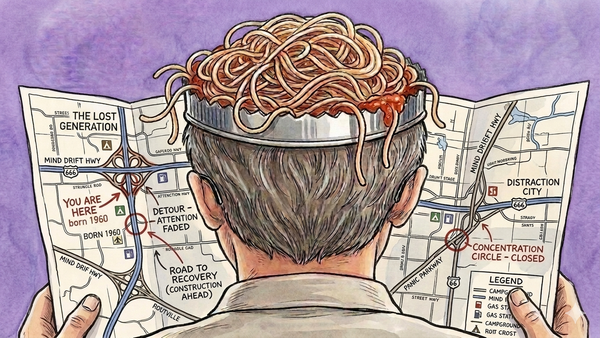
Amygdala Hijack Explained
Two guys walk into your brain’s control room...
Two walnut-sized structures? Of course...nuts for brains!
Have you ever found yourself reacting by snapping-off an inexplicable verbal outburst? Experienced a sudden mental freeze where your mind literally goes blank? How about the rush of a burning hot sensation in your head or neck while instantly feeling inexplicably furious over something that "shouldn't" have been a big deal? If so, you already know what an amygdala hijack feels like from the inside.
My AuDHD (autistic and ADHD) brain gets hijacked all the time...and usually at the worst times. So, Stevie Wondering (aka me) couldn't resist digging into the clinical science and research behind it all.
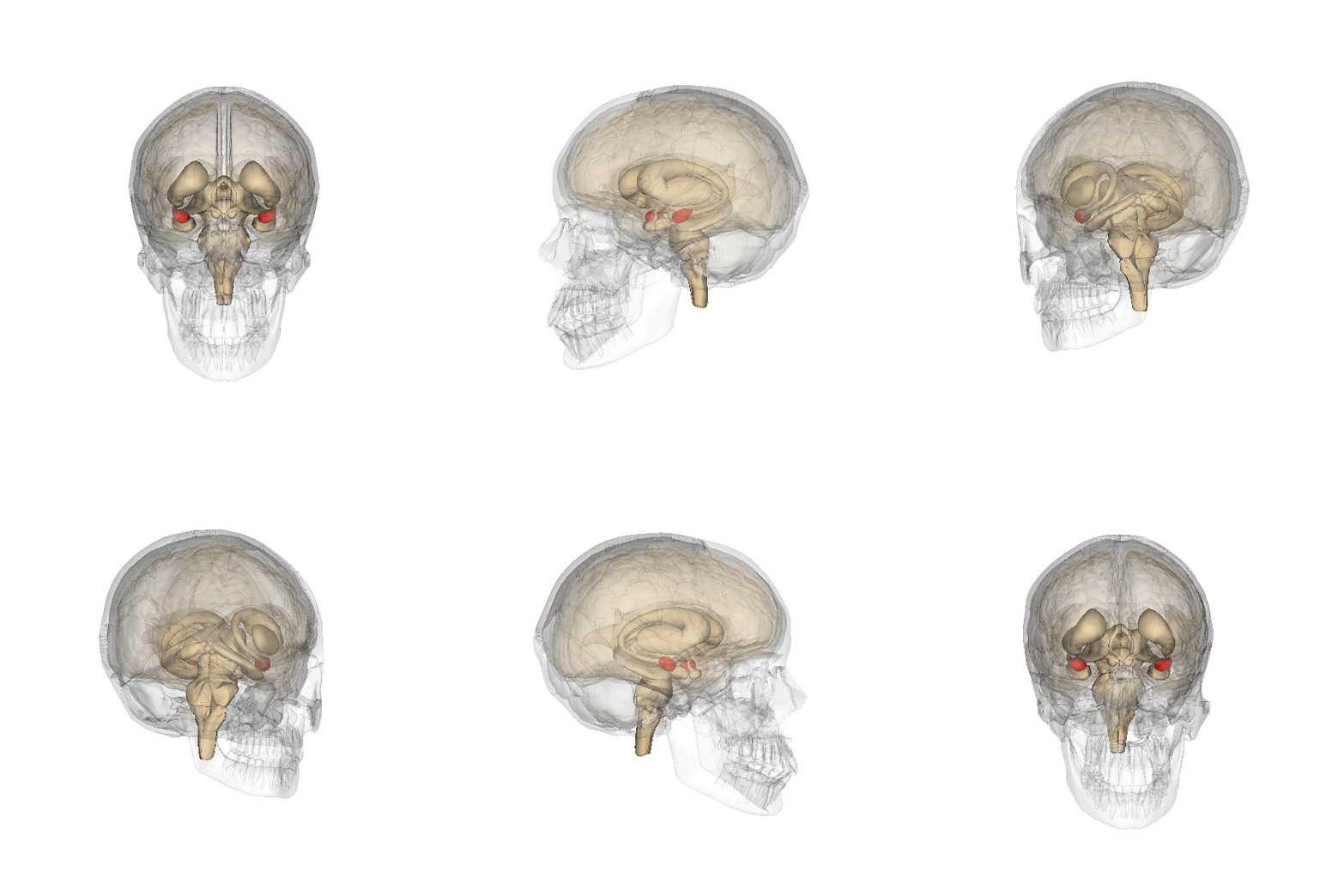
The amygdala (ah-MIG-dah-lah) is a small, walnut-sized structure deep inside our brains. Actually, we have two of them, red in the gif image above, one in each side. In every brain, they decide in a split second, whether or not something in our surroundings is a threat worth panicking about.
For autistic and/or ADHD (AuDHD) brains, those two amygdala guys tend to have very different enthusiastic interpretations of their job which results in a more intense experience for neurodivergent folks.
When the amygdala decides it has spotted danger, it does what neuroscientist Daniel Goleman famously called an amygdala hijack.[1] The "hijack" is the moment when our emotional, reactive brain completely overrides our rational, thinking brain. Before rational brain hass even a fraction of a second to weigh in, the alarm bells are going off.
Imagine your brain has two characters running the show:
Guy #1: Alarm Guy (Amygdala). He sits in the back of the control room, watching every single thing that comes through the door. His only job is to spot danger. He is fast, loud, and does not think carefully. He just reacts.[2]
Guy #2: PFC Manager Guy (Prefrontal Cortex, PFC). He sits at the big desk up front. He's thoughtful, calm, and good at making decisions. He can say, "Hey, wait. Let's think about this before we do anything." He also keeps Alarm Guy from completely losing his mind.[3]
What Normally Happens
In most situations, a message comes in, Manager Guy sees it first, thinks it through, and handles it like a reasonable adult. Alarm Guy keeps contemplating his half-eaten donut and stays in his chair.
But sometimes, a message comes in so fast and scary, it bypasses mellow Manager Guy and takes a shortcut straight to Alarm Guy.[2:1] So of course, Alarm Guy panics, hits every red button on the console, and floods the whole building...our body...with alarm bells in the form of chemicals: adrenaline and cortisol.[2:2]
Now Manager Guy's sitting there saying, "Wait?...what?" but by the time he hears about the problem, Alarm Guy has already locked the doors, cut the lights, and declared a state of emergency.
That total takeover by Alarm Guy is called an amygdala hijack.[2:3]
While the hijack is running, Manager Guy is basically locked out and can't do his job. Clear thinking? Gone. Good decisions? Gone. The ability to say, "calm down, it's fine"? ...also gone.[2:4]
Psychologist Daniel Goleman further describes an amygdala hijack in his 1995 book, Emotional Intelligence:
...the emotional brain overwhelming the rational brain before slower, deliberate processing can even kick in.[1:1]
Now Add Your Brain to the Mix
Here's the thing. In a normal, neurotypical brain, Manager Guy and Alarm Guy have a pretty strong line of communication between them. Manager Guy can call out Alarm Guy before he sounds the alarms mid-panic and fairly quickly talk him back down.[4]
In the AuDHD brain (autistic and ADHD), the communication line is thinner and the connection is weaker.[5] So when Alarm Guy starts losing it, Manager Guy's response doesn't get through as easily. On top of that, Autistic/ADHD Alarm Guy gets a trigger-finger over the alarm buttons ...meaning he panics over things that wouldn't even register as a blip for a neurotypical (non-autistic/ADHD) Alarm Guy.[3:1]
So for us neurodivergent wiring-types, it's not just that Manager Guy gets kicked out of the room faster. It's also that Manager Guy has a harder time getting back in once the hijack is over, because Alarm Guy has locked the door and temporarily lost his key.[5:1]
A Personal Example: The Unexpected Calendar Change
It's a Tuesday. You're busy at your desk with your day mentally mapped out. You know what you're doing, when, and in what order. That mental map is doing real work for your brain. You're feeling organized and oriented...efficiently productive. Safe.
Then at 10:55 a.m. you get a text: "Hey, can we move our 2pm call to 11? Like...right now?"
For a neurotypical person, this is mildly annoying. A small blip. Manager Guy in Brain Control Room reviews it, adjusts the schedule, gently tells Alarm Guy to chill. Your day moves on.
But your Alarm Guy, in Neurodivergent Brain Control Room #2, intercepts the message and sees full-on scheduling chaos. The calendar just got torn up. Trigger finger already twitching, Alarm Guy hits every button on the console before Manager Guy can even put down his coffee.[3:2]
In real time reactions, you might feel a sudden flash of heat or a spike of irritation, or maybe just a sudden inability to think clearly about anything.[2:5] You might snap a verbal response you really don't intend. You might freeze and stare at the phone. You might feel weirdly furious at a person who actually didn't do anything terrible.
I frequently feel that flash of heat when I'm completely engrossed in my morning Wordle ritual...when the sudden sound of a text on my phone in front of me interrupts my concentration. It's a completely involuntary response on my part, but I feel my head flush. Sometimes I have to work at not feeling irritated in response to it, before I can regain my focus on what I was doing.
That's not me being unreasonable. That's my neurodivergent Manager Guy getting knocked offline before he could say to Alarm Guy, "It's just a minor calendar change... Eat your donut, play your Wordle...we're fine."
And because the communication line between Manager Guy and Alarm Guy is weaker in our brains, the recovery isn't always quick.[5:2] Which is why we sometimes don't just shake it off in thirty seconds. The alarm chemicals are still sloshing around our brains. Manager Guy is still trying to get back to his desk, and it might take thirty seconds, or ten minutes, or longer, before we feel back to all skookum again.[3:3]
Everyday versions of the same hijack can trigger from things that look really small from the outside. It doesn't take a dramatic moment to set off Alarm Guy:[2:6]
- A loud, unexpected sound (a car alarm, a dropped pan, someone knocking hard)
- Sensory overload and crossing a threshold you didn't know you'd hit[4:1]
- A tone of voice that sounds like criticism, even if it wasn't meant that way
- Walking into a room and not knowing what the social situation is yet
- A piece of writing that isn't going the way you expected it to
In the moment, the maddening part is that the hijack can feel completely disproportionate to the trigger, even to ourselves. That gap between what happened and how big my reaction felt is one of the most isolating, despairing, and misunderstood parts of living in an autistic/ADHD (AuDHD) brain.
It's not drama. It's a difference in our wiring circuitry.[5:3]
When Alarm Guy Goes Nuts and Sidelines Manager Guy
I own my behavior when I react poorly and hurt someone during a sideways social situation. What is encouraging, if not a relief, is knowing that my failure is not so much about being overly sensitive or immature.
Learning and understanding more about how my brain is wired gives me real hope for improving my ability to better handle similar moments in the future.[6]
The fact is, our control rooms are wired differently, and nobody handed us an owner's manual for our brain.[6:1]
Which is to say that such awareness is motivation for me to keep learning about what's actually in my missing owner's brain manual.
Here's to catching our next amygdala hijack before things get too crazy,
—Steve
P.S. — Maybe take it easy on Alarm Guy next time...he's miswired too.
Endnotes
Goleman, Daniel. Emotional Intelligence: Why It Can Matter More Than IQ. Bantam Books, 1995. https://www.penguinrandomhouse.com/books/69105/emotional-intelligence-by-daniel-goleman/ ↩︎ ↩︎
Pietrangelo, Ann. "Amygdala Hijack: How It Works, Signs, & How To Cope." Simply Psychology, 2025. https://www.simplypsychology.org/amygdala-hijack.html ↩︎ ↩︎ ↩︎ ↩︎ ↩︎ ↩︎ ↩︎
Salines, Sharon. "Connecting Biology to Behavior in ADHD: The Amygdala's Role." Psychology Today, February 2025. https://www.psychologytoday.com/us/blog/mythbusting-adhd/202502/connecting-biology-to-behavior-in-adhd-the-amygdalas-role ↩︎ ↩︎ ↩︎ ↩︎
Gao, Wei et al. "Amygdala, the Brain's Threat Detector, Has Broad Roles in Autism." The Transmitter (Spectrum News), July 2020. https://www.thetransmitter.org/spectrum/amygdala-the-brains-threat-detector-has-broad-roles-in-autism/ ↩︎ ↩︎
Winters, Dana et al. "Reduced Amygdala-Prefrontal Functional Connectivity in Children with ASD." PMC / National Institutes of Health, February 2019. https://pmc.ncbi.nlm.nih.gov/articles/PMC7173634/ ↩︎ ↩︎ ↩︎ ↩︎
Inclusive ABA. "What Makes Autistic Brains Different?" InclusiveABA.com, 2025. https://www.inclusiveaba.com/blog/what-makes-autistic-brains-different ↩︎ ↩︎